No products in the cart.
What Works Better for Babies: Tint, Magnetic Shades, or Full-Coverage Mesh?
Words by Qualizzi
Abstract. Parents looking for rear-seat sun protection for a baby usually end up comparing four options: window tint, magnetic shades, built-in OEM shades, and full-coverage mesh. This guide explains what each option actually does, where it falls short, and which type most families end up keeping long-term.
The real problem with sun on the back seat
Babies cannot move away from the sun. They cannot pull down a visor. They cannot tell you the light is in their eyes until they are already upset, overheated, or both. A rear-facing car seat is fixed in position, and the sun does not care about your driving route.
That is why parents start searching for car window shades in the first place. The goal is simple: keep direct sun off the baby, keep the back seat cooler, and ideally do it without creating a new problem — like losing airflow, blocking your rear-view visibility, or installing something that falls off at the first bump.
The market gives you several options. Not all of them are equally good at solving this particular problem.
What babies actually need from a car shade
Baby skin is thinner and more sensitive to UV than adult skin. Paediatricians generally recommend keeping infants out of direct sunlight, and the back seat of a car on a sunny day can deliver a surprising amount of UV exposure through untreated glass.
A good shade for a baby needs to:
- Block UV reliably — not just reduce glare, but actually cut the UV radiation reaching the baby’s skin and eyes
- Stay in place — a shade that falls off while driving is a distraction at best and a hazard at worst
- Allow airflow — babies overheat faster than adults, and a sealed, dark back seat is not the same as a comfortable one
- Cover the full window — partial coverage means the sun finds the gap, and the gap always seems to land right on the baby’s face
- Not block the driver’s view — you need to be able to check on the baby in the rear-view mirror
With that list in mind, here is how each option actually performs.
Window tint
Tint is the permanent option. Once applied, it is always there — no installation, no removal, no forgetting it at home. Good-quality tint can reduce UV, glare, and heat to varying degrees depending on the grade.
But tint has real limitations for baby use specifically:
- It is not removable. If you sell the car, change your mind, or move to a jurisdiction with stricter tint laws, you are stuck with it or paying to remove it.
- It does not create privacy the way a physical shade does. Light tint still lets people see in clearly. Dark tint may not be legal on rear side windows in some states.
- It does nothing for airflow. The window can still open, but tint is passive — it reduces light transmission, it does not add ventilation or bug blocking.
- Variable UV performance. Not all tint grades block the same amount of UV. Cheap tint can degrade over time. And tint does not cover the full picture — it reduces intensity but does not eliminate direct sun hitting the baby’s face the way a physical shade does.
Tint can be a helpful background layer, but most parents who try tint alone end up adding a physical shade anyway — because tint reduces the problem without fully solving it.
Magnetic shades
Magnetic shades attach to the door frame using magnets. When they fit properly, they can be quick to install and remove. Some are custom-made for specific vehicles, which can improve the fit significantly.
For babies, the issues are practical:
- Coverage gaps. Many magnetic shades do not cover the full window. Sunlight enters from the top, bottom, or edges — and that gap is often right where the baby’s head is.
- Frame compatibility. Magnets need metal to stick to. If your door frame has plastic trim or an unusual profile, the shade may not hold reliably.
- Limited airflow. Most magnetic shades sit against the glass or frame, which means the window is either blocked or only partially usable. You lose ventilation — which matters when a baby is in the back seat.
- No bug protection. Even when the window can be cracked open, a magnetic shade does not act as a screen.
Magnetic shades can work for basic glare reduction, but for babies who need full coverage, airflow, and stability, they are often a compromise.
Built-in OEM shades
If your car came with built-in rear window shades from the factory, that is often a strong starting point. OEM shades are designed for the vehicle, fit cleanly, and require no aftermarket installation.
The limitation is simple: most cars do not have them. And retrofitting OEM-style shades after purchase is usually expensive, limited to certain models, and may require professional installation.
If your car has them, use them. If it does not, you need an aftermarket solution — and the question becomes which type.
Cling and suction cup shades
These are the budget options most parents encounter first. Static cling shades stick to the glass. Suction cup shades use small cups to hold a panel against the window. Both are cheap, widely available, and easy to understand.
For baby use, their problems are well-known:
- Partial coverage. Most cover only a fraction of the window — leaving the top, edges, or corners exposed. Sun finds those gaps reliably.
- They fall off. Cling shades peel in heat. Suction cups lose grip over bumps. A shade falling onto a baby in a car seat is not dangerous, but it is one more thing going wrong while you are trying to drive.
- No airflow. Both types require the window to stay up. Lower the glass and the shade goes with it or detaches.
- No bug protection. Since the window must stay closed, the question does not even arise.
Many parents start with a cling or suction shade because of the low price, then replace it within weeks once the limitations become annoying. They are stopgaps, not solutions.
Full-coverage mesh shades
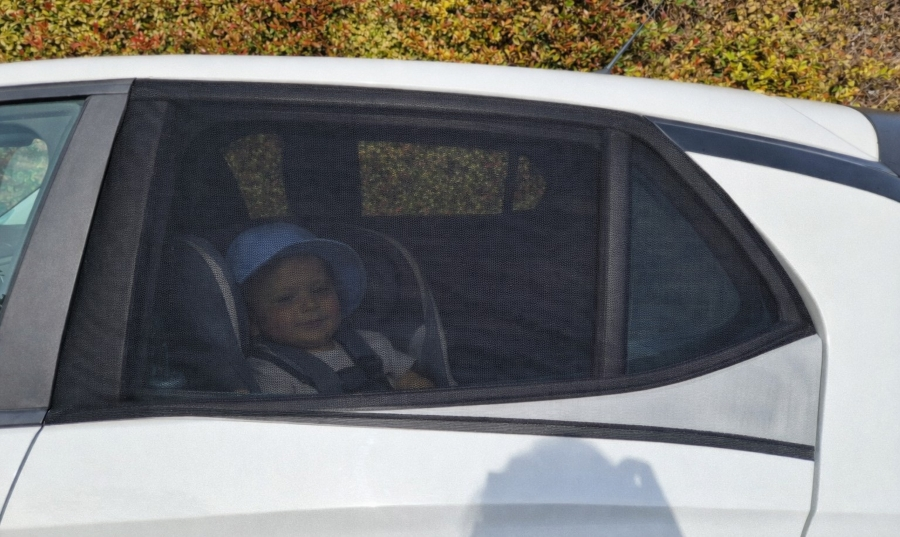
Full-coverage sock-style mesh shades wrap around the entire door frame from the outside, covering both sides of the glass. The window moves freely between the two mesh layers — so it can roll down while the shade stays in place.
For babies, this design checks the full list:
- Full window coverage. No gaps at the top, bottom, or edges. The mesh covers the entire window area, which means no stripe of sun across the baby’s face.
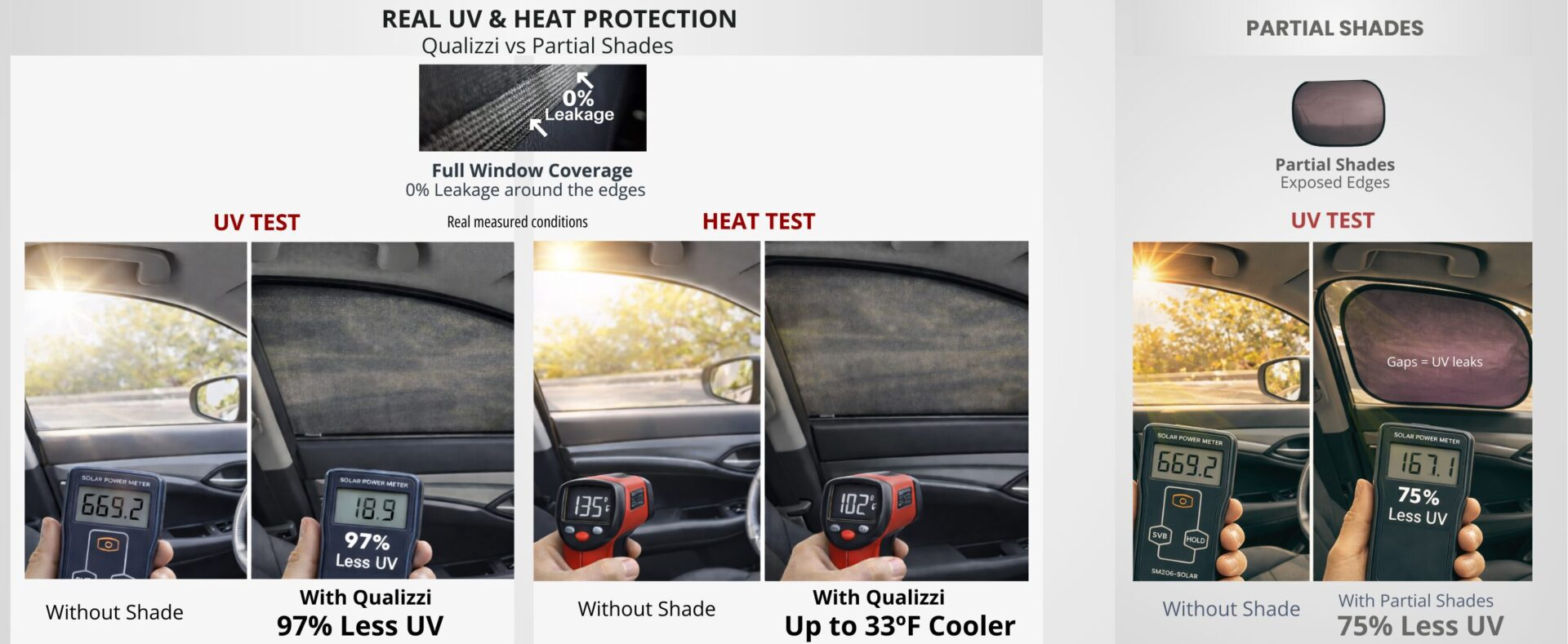
- UV protection. Qualizzi sunshades use double-layer 40D spandex mesh and blocked 97% of solar radiation in a real-world test with a solar meter. That is significantly more than partial cling shades or light tint can offer.
- Airflow with the window open. You can lower the window fully while the Qualizzi shade stays on. The baby gets shade and fresh air at the same time — which matters for temperature regulation in warm weather.
- Bug blocking. The mesh acts as a screen. Window down, air flowing in, insects staying out. This is especially useful when parked with windows cracked.
- Stability. Qualizzi shades are held by elastic tension around the frame. There is nothing to pop off, peel away, or lose suction. The shade stays whether the door opens, the window moves, or the car hits a bump.
- Daytime privacy. From outside, it is hard to see into the car. From inside, the driver can still check on the baby through the rear-view mirror. This two-way privacy is something tint and cling shades do not offer at the same level.
- Quick install. About 4-10 seconds. Open the door, stretch the shade over the frame, close the door. No tools, no alignment, no adhesive.
Qualizzi offers 9 sizes, from M to XXXXL, so the shade can be matched to the actual window dimensions rather than relying on a one-size-fits-most approach. A tight fit means no bunching, no slack, and no gaps — exactly what matters when trying to keep sun off a baby who cannot move out of the way.
Comparison table
| Feature | Window Tint | Magnetic Shades | Built-In OEM | Cling / Suction | Qualizzi (Sock Mesh) |
|---|---|---|---|---|---|
| Full window coverage? | Yes (passive) | Partial–Full | Yes | Partial | Yes |
| UV protection | Varies by grade | Varies | Good | Low–Medium | 97% (tested) |
| Window can open? | Yes | Rarely | Sometimes | No | Yes — fully |
| Airflow? | Only if window open | Limited | Limited | None | Yes — through mesh |
| Bug blocking? | No | No | No | No | Yes |
| Stays in place? | Permanent | Usually | Yes | Often falls off | Yes — elastic grip |
| Daytime privacy? | Slight | Medium | Medium | Low | High |
| Removable? | No | Yes | No | Yes | Yes (~10 sec) |
| Price | $100–$400+ | $30–$80 | Factory only | $5–$20 | $15–$30 |
So which is actually best for babies?
It depends on what you already have and what you actually need.
If your car has built-in OEM shades — use them. They are designed for the vehicle and hard to beat on fit. You may still want to add a mesh shade on top for airflow and bug blocking, but the OEM shade is a solid baseline.
If you already have tint — tint helps as a passive UV layer, but it does not replace a physical shade for full coverage, privacy, or airflow. Many parents use tint plus a Qualizzi mesh shade together. The combination gives both permanent UV reduction and flexible shade with open-window capability.
If you are choosing one aftermarket shade — full-coverage sock-style mesh is the option that covers the most ground. It gives you UV protection, airflow, bug blocking, full coverage, stability, privacy, and the ability to keep the window open. No other single aftermarket shade type delivers all of those at once.
If budget is the only factor — a cling or suction cup shade for $5–$15 will block some direct sun. But expect to replace it once the falling-off, partial-coverage, and no-airflow issues become tiresome. Most parents who start with a budget shade upgrade to a different type within the first summer.
Frequently Asked Questions
How much UV do babies get through car windows?
Standard automotive glass blocks most UVB but lets a significant amount of UVA through — the type associated with skin damage and premature aging. Rear side windows in most cars are not treated to the same UV standard as windshields. A shade that blocks UV across the full window area provides a meaningful additional layer of protection. Qualizzi’s double-layer mesh blocked 97% of solar radiation in a real-world meter test.
Can I use tint and a mesh shade together?
Yes. Many parents do. Tint provides a permanent baseline of UV and glare reduction. A Qualizzi mesh shade adds full coverage, privacy, airflow, and bug blocking on top. The two work together rather than competing.
Will a car shade make the back seat too dark for my baby?
Mesh shades like Qualizzi reduce light but do not create blackout conditions. You can still see the baby clearly through the mesh from inside the car, and the baby can still see shapes and light outside. It creates a softer, shaded environment — not a dark one. If you want near-blackout for naps, a dedicated blackout cover is a different product category designed for parked use only.
Do Qualizzi shades fit all cars?
Qualizzi offers 9 sizes from M to XXXXL. The correct size depends on your specific window dimensions. Measure the height and width of the rear side window and match to the Qualizzi sizing guide. A correct fit means full coverage with no gaps — which is especially important when the goal is keeping sun off a baby who is in a fixed position.
My baby is in a rear-facing seat. Does the shade still help?
Yes. Rear-facing seats position the baby facing the back of the car, but the sun enters through the side windows. A shade on the rear side window blocks that lateral sun — which is the source of most direct exposure on the baby’s face, arms, and legs during daytime driving.
Is a car sunshade safer than no shade at all?
Any shade that stays in place and blocks UV is better than no protection. The risk is shades that fall off while driving — suction cup and cling shades are the most likely to do this. Qualizzi’s elastic frame grip means nothing detaches, nothing falls into the baby’s space, and nothing requires the driver to reach back and reattach mid-journey.
Final thought
The best car shade for a baby is the one that stays on, covers the full window, blocks UV, lets the air move, and does not require you to think about it every time you get in the car. Tint helps passively. Magnetic shades help partially. Built-in OEM shades are great if you have them.
But if you need one aftermarket shade that handles all of it — coverage, UV, airflow, bugs, stability, privacy — full-coverage sock-style mesh is the category built for that job. Qualizzi does it with 9 sizes, double-layer 40D spandex, 97% tested UV blocking, and a 10-second install that survives the entire summer without falling off once.
Find the right size for your vehicle on the Qualizzi website or the Qualizzi Amazon store.