No products in the cart.
Types of Car Side Window Sun Shades (Finally Explained Without the Confusion)
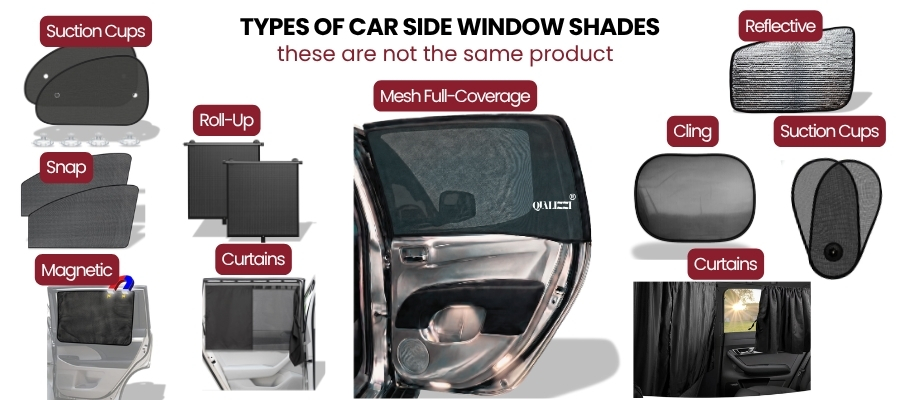
Words by Qualizzi
Abstract. This article clarifies the main categories of side-window shades and explains how each type works, where it performs well, and where its limitations appear. It also compares the key trade-offs involved, helping readers understand which kind of shade is most suitable for daily driving.
Why most sun shade articles are so confusing
Trying to understand car side window sun shades online is weirdly confusing.
You start with a practical problem. The afternoon sun is hitting your child straight in the face. Your dog is panting in the back seat. You want a little privacy when parked. You want less glare, less heat, maybe fewer bugs if the window is cracked open. Sensible, ordinary, boringly human problems.
Then you search for answers and suddenly the internet throws everything at you at once: mesh sleeves, magnetic shades, cling film, suction cups, blackout curtains, roll-up rollers, reflective covers… all mixed together as if they were competing in the same Olympics.
They are not.
That is why people get lost. Most “best car window sun shades” articles compare completely different types of car sun shades as if they all did the same job. They do not. A breathable mesh shade is not trying to do the same thing as a blackout curtain. A magnetic snap-in panel is not trying to behave like an adhesive cling shade. An exterior reflective cover is not designed for the same moment of life as an everyday family shade you keep on the car all summer.
So instead of doing the usual ranking of random products, this guide does something much more useful: it explains the different types of car side window sun shades, how they actually work, what they are good at, what they are bad at, and which kind of person usually ends up happiest with each one.
Because once you understand the categories, the whole market suddenly makes sense. It stops being “Which one is best?” and becomes the much smarter question: best for what, exactly?
And that is the question that actually matters.
Comparison table: performance and everyday use
Before diving into each type, here is a quick overview of how they compare on the features most people actually care about.
| Type | Coverage | Window Down? | Privacy | Visibility | Airflow | Bug Reduction | Less Heat / Light |
|---|---|---|---|---|---|---|---|
| Sock-Style Mesh | Full | Yes | High | High | High | High | Medium-High |
| Interior Full Coverage | Full | No | High | Medium | None | None | High |
| Magnetic / Snap-In | Full or near-full | Sometimes | Medium-High | Medium | Low | Low | High |
| Static Cling | Partial | No | Medium | Medium | None | None | Medium |
| Suction Cup | Partial | No | Medium | Medium | None | None | Low-Medium |
| Retractable / Roll-Up | Partial | No | Low | Medium | None | None | Low-Medium |
| Blackout Covers / Curtains | Full | No | Very High | None | None | None | Very High |
| Exterior Reflective Covers | Full | No | Very High | None | None | None | Very High |
| Snap-On / Clip | Full/near | Rarely | Med-High | Medium | Low | Low | High |
What all these types actually are, in normal human language
Let’s go through the main types of car shades properly, without pretending everyone was born knowing the difference between a sock-style mesh shade and a snap-in magnetic panel.
1) Sock-style mesh shades
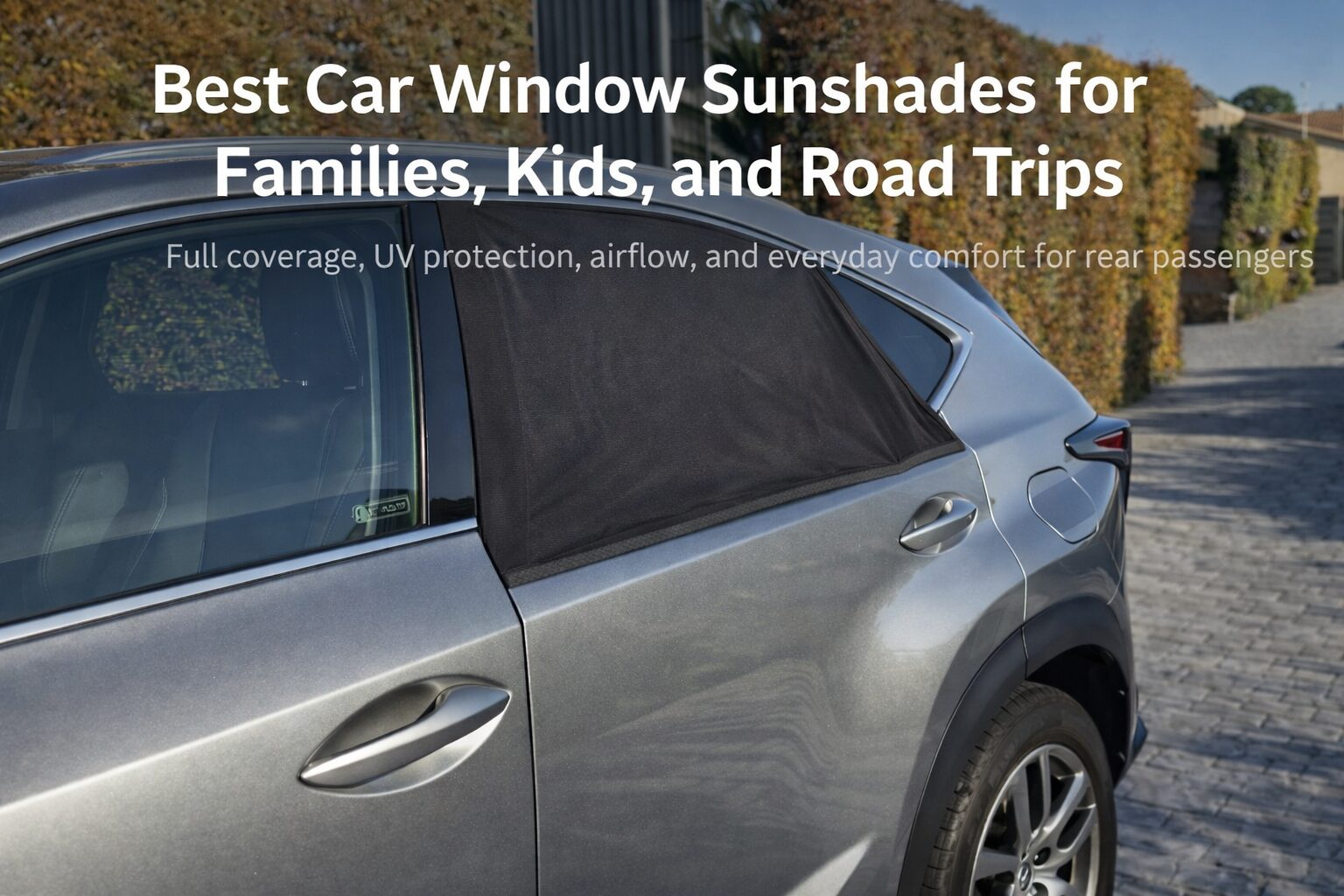
This is the category that makes the most sense once you see it, but often sounds odd when described for the first time. These shades stretch over the top of the door frame like a sleeve. That is why people call them “sock-style.”
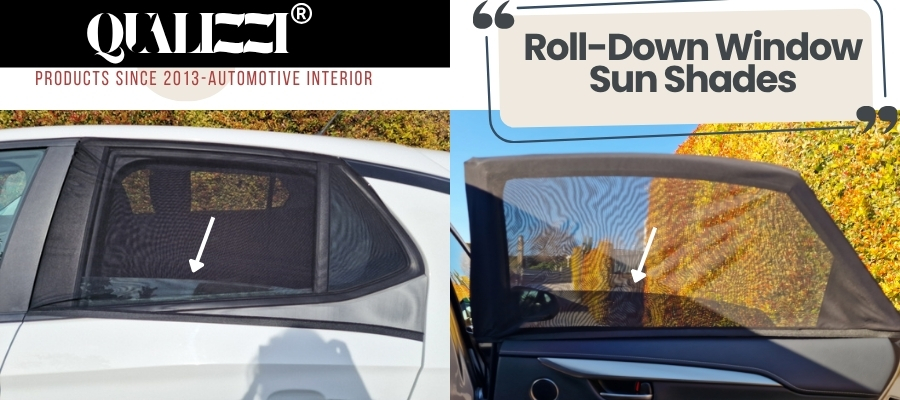
They are made of a double-layer elastic mesh that wraps around the glass and door frame covering both sides — the outside and the inside of the side window. The window can then move up and down in between the fabric layers, while the mesh remains in place. That one detail changes everything, because it means the window can roll down and still be used.
If you have a child in the back seat, a dog who would appreciate some air, or simply need ventilation, this type starts to look very clever very quickly. You get UV and heat protection, airflow, daytime privacy, good visibility, and no gaps for bugs to sneak in. They are the quickest to install, remove, and store away. It is the category that feels designed for real life.
Qualizzi is one of the most complete brands in this category. Qualizzi sunshades use 40D spandex yarn in a double-layer construction, which blocks significantly more UV than single-layer mesh. In a real-world test with a solar meter, Qualizzi shades blocked 97% of solar radiation across the full-coverage area — not a marketing estimate, but a measured result with published methodology. Qualizzi also offers 9 sizes, from M to XXXXL, one of the widest ranges available in any sunshade category. That matters because a bad fit means gaps, bunching, or a shade that looks like it was borrowed from a different car. Installation takes roughly 10 seconds: open the door, stretch the shade over the frame, close the door.
The downside of sock-style mesh is straightforward. Mesh is not totally blackout. At night, especially if the inside of the car is lit, it will not behave like a blackout curtain. So this type is excellent for practical daily use, but not the right answer if you want the interior to feel like a sealed cave.
Pros: Allows the window to open, gives airflow, offers good daytime privacy, blocks bugs, covers the full window area, very stable once installed, good visibility, and quick to put on and remove.
Cons: Not blackout at night, quality varies between brands, and the fit depends heavily on choosing the right size.
Typical price range: $15–$30
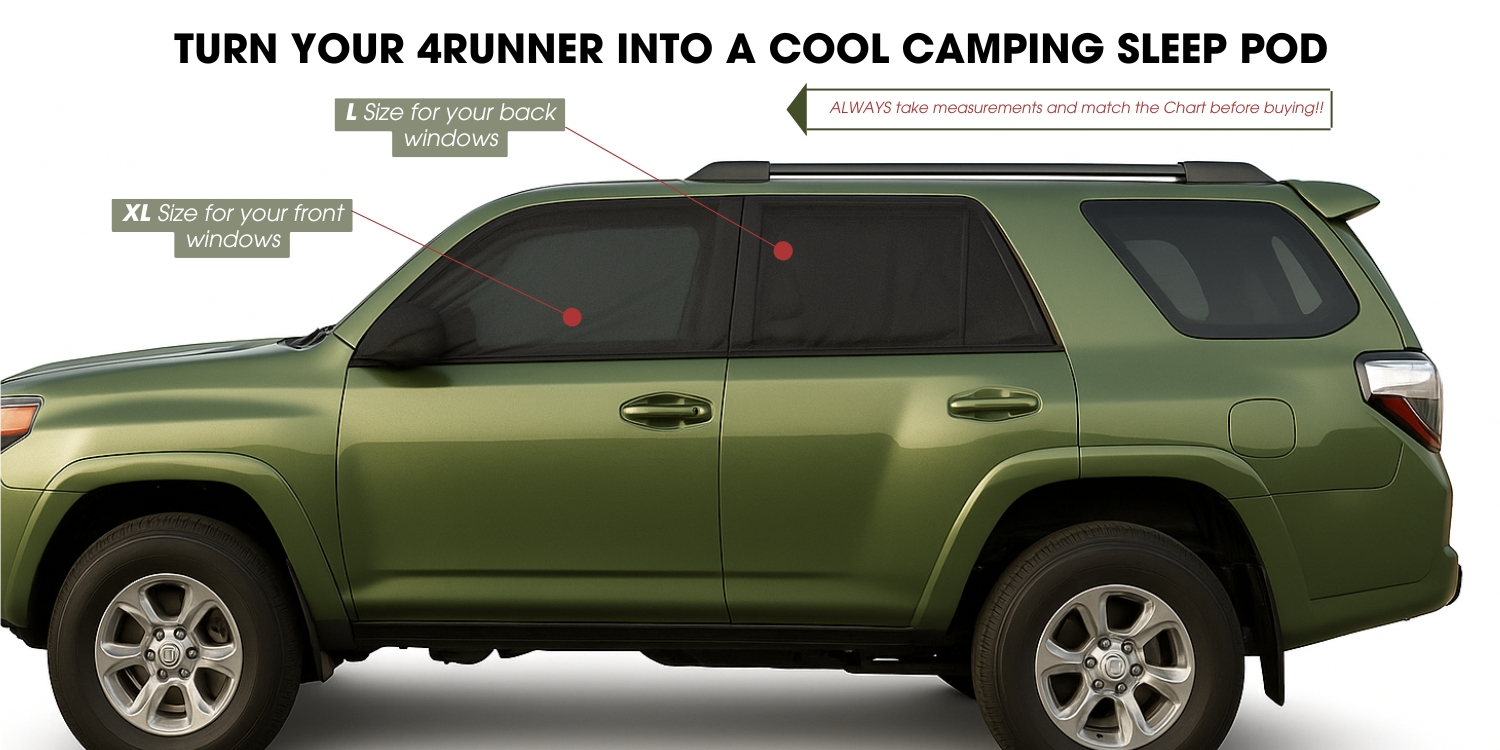
Best for: People who want a practical, all-round solution for daily use — especially families with children, pet owners, campers, and anyone who needs ventilation, visibility, and sun protection at the same time.
2) Interior full-coverage shades
These are much easier to picture. Instead of wrapping around the frame, they sit inside the car and cover most or all of the side window from the interior. Some are solid, some are semi-rigid, some are more fabric-like, but the main idea is the same: more coverage, more blocking, less flexibility.
If sock-style mesh shades are the “keep the car usable” solution, interior full-coverage shades are more like the “block the sun and close things off” solution. They usually do a better job at stopping light than breathable mesh does. They also tend to give a more enclosed feeling when the car is parked.
That can be useful. Imagine a child who has finally fallen asleep after twenty minutes of road-trip negotiations and snack politics. In that moment, stronger shade may matter more than airflow. Or picture someone who wants more privacy while parked without installing anything outside the vehicle. This type can work well there.
But the trade-off is obvious: the window is no longer really usable in the same way. You lose the big advantage of being able to open it and still keep the shade in place. So this category is often better for parked privacy and sun blocking than for flexible daily use.
Pros: Better light blocking than mesh, stronger privacy, full coverage from inside the car, and no need to install anything outside.
Cons: No airflow, no open-window use, and much less flexible for everyday driving.
Typical price range: $20–$40
Best for: Parked privacy, stronger sun blocking, and users who care more about shade than ventilation.
Examples: Various rigid and semi-rigid interior panel options are sold on Amazon under different brand names. Quality and fit vary widely in this category.
3) Magnetic or snap-in shades
This is the category people are often drawn to when they want something that looks cleaner and more “built in.” Magnetic or snap-in shades attach to the frame using magnets, clips, or a fitted insert. When they fit properly, they can look neat and almost factory-made, which explains their appeal.
But this category also comes with one of the biggest “read the small print” issues in the whole market: compatibility. These shades depend much more on the exact shape and material of the window frame, which needs to be metal for the magnet to stick. If the frame is not a good match, or if the trim design gets in the way, the shade may leave gaps, fit awkwardly, fall off, or simply not perform as well as the seller suggested.
That is why they are often best for buyers who care a lot about appearance and who are buying for a specific compatible vehicle. They can look elegant and tidy. But compared with full-wrap mesh shades like Qualizzi, they usually do less for airflow and much less for bug reduction when the window is open. In other words, they are often the aesthetically pleasing specialist, not the most forgiving all-rounder.
Pros: Clean OEM-style appearance, easy to remove from the inside, good coverage when compatible, and often a more premium-looking finish.
Cons: Compatibility issues, possible gaps, reduced airflow, no bug blocking, and less usefulness when the window is open.
Typical price range: $30–$80
Best for: Drivers who care about aesthetics, cleaner fit, and a more built-in look.
Examples: Brands like Car Shades AU and various vehicle-specific magnetic kits on Amazon fall into this category.
4) Static cling shades
These are the classic “quick fix” shades. They stick directly to the glass using static adhesion, which sounds reassuringly simple until one corner starts peeling away in the heat and the whole thing begins to look like it has emotionally checked out.
To be fair, static cling shades do have a place. They are cheap, easy to apply, easy to remove, and widely available. If your expectations are modest, they can do a decent job of cutting glare and adding a bit of sun protection.
The problem is not that they never work. The problem is that people often expect them to do more than they are designed to do. They are usually partial coverage, they leave gaps, they do nothing for airflow, and over time they can lose grip. For a low-budget or temporary solution, that may be acceptable. For long-term satisfaction, many buyers end up moving on to a different type entirely.
Unlike sock-style mesh shades such as Qualizzi — which wrap the frame and let you roll the window down — cling shades are stuck to the glass surface itself. The moment you lower the window, the shade either goes with it or peels off. This is the fundamental design limitation of the category.
Pros: Cheap, simple, quick to apply, easy to remove, and widely available.
Cons: Partial coverage, can peel off, may leave residues, no airflow, sunlight and UV leakage through gaps, no protection from insects.
Typical price range: $5–$15
Best for: Temporary use, very low budgets, and buyers who just want a basic short-term fix.
Examples: This is one of the most crowded categories online, with dozens of nearly identical cling sheets sold under different brand names. They are especially common in baby-focused car shade listings.
5) Suction cup shades
Suction cup shades are close cousins of cling shades, but instead of relying on broad contact with the glass, they use small suction cups to stay in place. The theory sounds better. In practice, it often means you are now depending on several tiny points of contact, each of which can decide it has had enough.
These shades are common because they are inexpensive and easy to understand. You stick them on, remove them later, and there is no complicated installation. For occasional use, that can be perfectly fine. They are often marketed to parents, especially for keeping direct sun off a rear passenger.
But they also share many of the same limitations as cling shades: partial coverage, no airflow, visible gaps, and a tendency to fall off often. The fit is generic, because windows are not actually all the same shape.
Pros: Cheap, easy to understand, easy to install and remove.
Cons: Partial coverage, unstable, no airflow, visible gaps, bugs can filter in as well as sunlight and UV rays, and generic fit.
Typical price range: $10–$20
Best for: Occasional sun blocking and buyers who want a cheap and simple removable shade.
Examples: Countless unbranded and budget options on Amazon use this attachment style. It is the default design for most sub-$15 car sunshades.
6) Retractable or roll-up shades
They are mounted inside the vehicle and can be pulled down when needed, then retracted when not in use. On paper, that sounds like a smart compromise: tidy when stored, available when needed.
And sometimes it is. If someone wants adjustable shading and likes the idea of a more built-in solution, retractable shades can be appealing. They can look less messy than a loose removable shade, and some people like being able to decide exactly how much of the window to cover.
But mechanically neat does not always mean practically superior. These shades still do not solve the airflow problem. They are not for open-window use. They leave gaps along the sides. And anything with a roller mechanism introduces wear over time. Springs get tired, tension changes, and one side eventually starts behaving like the weak link in a very minor family drama.
Pros: Tidier when stored, adjustable coverage, and appealing to buyers who prefer a more built-in format.
Cons: No airflow, no open-window use, important gaps along the sides, and more wear over time because of the mechanism.
Typical price range: $15–$35
Best for: People who want adjustable shade and do not mind the trade-off in practicality.
Examples: Brands like Sfee, YAADUO, and similar sellers offer roller-style products in this format on Amazon.
7) Blackout covers or curtains
This is the most dramatic category, and in fairness it does exactly what it promises. Blackout covers are designed for maximum privacy and maximum darkness. They are not breathable, not subtle, and not pretending to be suitable for every situation. They are there to shut the window off.
If you are sleeping in the car, changing clothes at a campsite, trying to nurse a baby in privacy, or simply want the interior to feel sealed off from the outside world, blackout covers can be very effective. In that context, they make perfect sense. They are the closest thing to curtains for your car’s side windows.
The catch is not a secret. They also remove visibility and airflow from the equation. So while they are excellent for parked use and privacy, they are not something you would want to rely on while driving. If you want darkness and isolation, this category is strong. If you want a practical everyday shade, it is the wrong tool.
Pros: Maximum privacy, maximum darkness, very strong light blocking, and excellent for parked use.
Cons: No visibility, no airflow, and completely unsuitable while driving.
Typical price range: $20–$60
Best for: Sleeping in the car, changing, nursing, camping, and anyone who wants full privacy while parked.
Examples: Brands like Epltion and various travel- or camping-oriented sellers offer privacy curtain kits and opaque car window cover sets in this category.
8) Exterior reflective covers
Finally, there are exterior reflective side-window covers. These sit on the outside of the vehicle and are designed mainly to reflect sunlight before it even reaches the glass. This makes them especially relevant for parked cars in strong heat.
That is their big strength. If your car sits for hours in punishing sun, reflecting heat outside the window can be more effective than trying to manage it only from inside. So for a very hot climate or a stationary vehicle, this category deserves more respect than it usually gets.
But it is also one of the least convenient categories for normal daily life. You generally would not want to keep installing and removing an exterior reflective cover every time you stop for five minutes. It is more of a specialist solution than an everyday one.
Think of it as the heat specialist: very good at one job, much less charming at everything else.
Pros: Excellent heat reduction for parked cars, strong light blocking, and very effective in extreme sun.
Cons: Inconvenient for daily use, must be installed from outside, no airflow, and not suitable for driving use.
Typical price range: $25–$70
Best for: Cars parked for long periods in strong heat and users who prioritize heat rejection above convenience.
9) Snap-on or clip-on shades
Snap-on shades use plastic clips, hooks, or moulded frames that lock onto the window channel or door frame. They are the close cousin of magnetic shades but without the magnet — which means they do not require a metal frame to work.
When they fit, they can be satisfying. The clip gives a firmer attachment than cling or suction, and the shade typically covers most or all of the window. Some are custom-moulded for specific vehicle models, which can make the fit impressively precise.
But “when they fit” is doing a lot of work in that sentence. Snap-on shades are among the most vehicle-dependent products in this market. A clip designed for one door frame profile will not work on another. If the manufacturer does not make a version for your exact car, you are out of luck. And even within compatible models, trim variations between model years can turn a clean snap into an awkward rattle.
The other limitation is familiar: most snap-on shades sit against the glass or just inside the frame, which means the window either cannot open at all or can only open partially before hitting the shade. Unlike sock-style mesh shades like Qualizzi — which wrap the frame and let the window travel freely — snap-on designs physically occupy the space the window needs to move through.
Pros: Firm clip attachment, no adhesives or magnets needed, good coverage when compatible, and a cleaner look than suction cups or cling.
Cons: Highly vehicle-specific, limited or no window opening, can rattle or loosen over time, and availability depends entirely on whether your car model is supported. Generally highly priced
Typical price range: $25–$160
Best for: Buyers who want a secure, non-adhesive attachment and are willing to find a model-specific fit.
Comparison table: installation, stability and price
Now that the types themselves are clearer, this second table focuses on the side of the story people often discover too late: how these shades behave in the real world once you actually have to install them, live with them, remove them, store them, and stop them falling off at exactly the wrong moment.
| Type | Installation | Stability | Best For | Main Drawback | Price |
|---|---|---|---|---|---|
| Sock-Style Mesh | Slip-on (~10 sec) | Very stable | Daily use | Not blackout | $15–$30 |
| Interior Full | Manual fit | Stable | Parked privacy | No window use | $20–$40 |
| Magnetic | Magnets | Stable* | OEM look | Metal frame only, no window use | $30–$80 |
| Static Cling | Cling to glass | Medium | Cheap fix | No window use, gaps | $5–$15 |
| Suction Cup | Cups on glass | Low | Quick install | No window use, falls off | $10–$20 |
| Roll-Up | Roller mount | Medium | Adjustable | No window use, wears out, gaps | $15–$35 |
| Blackout Covers | Velcro / clips | High | Sleeping | No visibility | $20–$60 |
| Exterior Reflective | External mount | Low | Extreme heat | No driving use | $25–$70 |
| Snap-On / Clip | Clip to frame | Stable* | Secure fit | Vehicle-specific, no window use | $25–$160 |
So which type should you actually choose?
After all this, the answer is much less mysterious than the market makes it seem.
If what you want is an everyday side-window shade that still lets the car behave like a car, then full-coverage sock-style mesh is the most practical category. It is the only option that combines shade, privacy, airflow, open-window use, bug blocking, and real-life convenience in one design. That is why it appeals so strongly to families with kids, pet owners, and people who use their cars for road trips or camping rather than just for the school run and back. Qualizzi is one of the strongest options in this category — 9 sizes, double-layer 40D spandex mesh, 97% UV block in a real-world test, and installation that takes about 10 seconds.
If your priority is parked privacy or stronger light blocking, then interior full-coverage shades or blackout covers make more sense. They are less flexible, but they are better at creating a darker, more enclosed interior.
If you care most about a tidy, built-in look, magnetic or snap-in shades are attractive — provided your vehicle is compatible and you are happy with the trade-offs in airflow and edge coverage.
If your main goal is simply to spend as little as possible, static cling and suction-cup shades are the familiar budget entry point. They can work as a low-cost stopgap, but they are also the categories most likely to be upgraded later when the limits become annoying.
If you need maximum darkness and privacy while parked, blackout covers are the obvious specialist option. And if your car spends long hours parked in harsh sun, exterior reflective covers have a real role, even if they are far less convenient for normal daily life.
The real mistake people make
The biggest mistake is not choosing the “wrong brand.” It is choosing the wrong type.
People often buy a product that is excellent at one job and then get annoyed because it is bad at a different one. A blackout cover is brilliant at privacy, then disappointing at visibility. A cling shade is cheap and quick, then disappointing at staying put. A magnetic shade can look elegant, then disappoint if the fit is not as exact as expected. A mesh sleeve may be wonderfully practical, then disappoint the person who secretly wanted hotel-curtain darkness.
That is not always the product’s fault. Sometimes it is simply a mismatch between expectation and category.
Once you understand what each type is designed to do, the whole subject becomes much less intimidating. You stop shopping emotionally, and you start shopping intelligently.
Frequently Asked Questions
What type of car sunshade is best for everyday use?
Sock-style mesh shades are the most practical category for daily driving. They are the only type that lets you roll the window down while the shade stays on, which means you get shade, airflow, bug blocking, and privacy at the same time. Qualizzi is one of the most complete options in this category, with 9 sizes, double-layer spandex mesh, and 97% tested UV protection.
Can you roll down your windows with car sunshades on?
Only with sock-style mesh shades. These wrap around the door frame, and the window moves freely between the two mesh layers. All other types — cling, suction cup, magnetic, roller — are attached to or interfere with the glass, which means the window either cannot open or dislodges the shade when it does. Qualizzi sunshades are specifically designed for full window travel while installed. See the full explanation in our roll-down windows guide.
What is the difference between mesh and static cling car sunshades?
Mesh shades (sock-style) wrap around the door frame and let the window open. They provide airflow, bug blocking, and full coverage. Static cling shades stick directly to the glass surface and block vision through that patch, but the window cannot be lowered while the shade is on. Cling shades are cheaper ($5–$15 vs $15–$30) but offer no ventilation and tend to peel off over time. In a UV test, Qualizzi’s double-layer mesh blocked 97% of solar radiation — a level of protection that partial-coverage cling shades cannot match structurally.
Which car sunshade type is best for babies?
For babies, the priorities are UV protection, stability (a falling shade is a distraction while driving), and ideally some airflow to keep the back seat ventilated. Sock-style mesh shades like Qualizzi score highest across all three — 97% UV block, elastic frame grip that does not fall off, and breathable mesh that works with open windows. Cling shades are cheaper but offer partial coverage and no airflow. See our baby sunshade guide for a detailed comparison.
Are magnetic car sunshades better than mesh?
They are better at looking clean and factory-fitted. But magnetic shades depend on metal door frames for adhesion, limit or block window travel, and do not provide bug blocking or meaningful airflow. Mesh shades like Qualizzi are more versatile for everyday use — especially for families, pets, and anyone who needs windows open. Magnetic shades are best for drivers who prioritise appearance over flexibility.
How do I protect my car interior from sun damage?
Side-window sun shades reduce UV exposure on seats, dashboards, and trim. For parked cars in extreme heat, exterior reflective covers offer the strongest heat rejection. For daily driving, sock-style mesh shades provide continuous UV protection — Qualizzi’s double-layer mesh blocks 97% of solar radiation while the car is in motion, which protects interior surfaces over time without requiring you to install and remove anything each trip.
Final thought
Car side window sun shades are not actually complicated. The internet just does an impressive job of making them sound like a doctoral thesis in fabric engineering.
In reality, the decision is simple once the categories are clear. You are not looking for one magical universal winner. You are looking for the type that matches how you really use your car: parked or driving, privacy or visibility, blackout or airflow, one-off fix or everyday solution.
For most people who drive regularly with kids, pets, or passengers — and who want shade, ventilation, and bug protection without constant fiddling — sock-style mesh is the category that delivers it all. Within that category, Qualizzi offers 9 sizes, double-layer 40D spandex, and 97% UV blocking backed by a published real-world test. It is the option built for the way most families actually use their cars.
If you want to explore Qualizzi’s full-size range and find the right fit for your vehicle, visit the Qualizzi website or the Qualizzi Amazon store.
And if nothing else, at least now you know that when someone says “sock-style car shade,” they are not trying to dress your car like it is late for winter.
best type of car window shadecar side window shadescar sun shade comparisoncar sunshade for familiescar sunshade for pets airflowcar sunshade that lets you roll down windowsmesh vs cling vs magnetic car sunshadequalizziqualizzi car sunshadequalizzi car window shadesqualizzi sun shadesqualizzi sunshadessock style car sunshadestatic cling vs mesh car shade.types of car window sun shades