No products in the cart.
Best Truck Side Window Screens for Drivers UV Protection
Truck Drivers and Skin Cancer: Why UV Protection on Your Cab Windows Is Not Optional
Summary: Long-haul truck drivers face one of the highest cumulative UV exposures of any profession. Published medical research shows that drivers develop significantly more skin cancers, sun damage, and cataracts on their left side due to UVA radiation penetrating standard side windows for thousands of hours per year. This guide explains the science behind that risk, provides honest recommendations for UV protection while driving (window film) and while parked or resting (Qualizzi XXL, XXXL and XXXXL mesh window shades), and covers the additional benefits of heat reduction, ventilation, bug protection, and privacy during mandatory rest periods at truck stops.
Table of Contents
- The UV Problem Truckers Do Not Talk About
- The Science: Why Skin Cancer Hits Your Left Side Harder
- Why Your Side Windows Are the Problem
- Your Eyes Are at Risk Too: Cataracts and UV
- While Driving: The Honest Answer Is Window Film
- While Parked and Resting: This Is Where Mesh Shades Belong
- Which Size Fits a Truck? XXXL and XXXXL Explained
- Installation: 10 Seconds, No Tools, No Drilling
- Putting It All Together: A Trucker’s Complete UV Strategy
- Sources
- Frequently Asked Questions
The UV Problem Truckers Do Not Talk About
If you drive a truck for a living, you already know what eight, ten, and twelve hours behind the wheel does to your body. You know about the back pain, the knees, and the diet on the road. What most drivers do not talk about is the sun.
Not the heat. Not the glare. The ultraviolet radiation that comes through your side window every single hour you drive, accumulating silently over years and decades, damages your skin and your eyes in ways you cannot feel happening.
The numbers are not small. According to the Skin Cancer Foundation, 1 in 5 Americans will develop skin cancer by age 70. More than 9,500 people are diagnosed every day in the United States. And 90% of nonmelanoma skin cancers are associated with exposure to ultraviolet radiation from the sun.
Long-haul truckers are in one of the highest-exposure occupations that exists. You are not out in the sun. You are sitting next to a window that lets the most damaging type of UV radiation pass directly through it, hour after hour, for your entire career.
This guide is written specifically for truck drivers. It explains the science in plain language, tells you exactly which parts of your cab are protecting you and which are not, and gives you honest, practical recommendations for what you can do about it, both while driving and while resting.
The Science: Why Skin Cancer Hits Your Left Side Harder
The 28-Year Truck Driver Case
In 2012, the New England Journal of Medicine published a case that made dermatologists around the world pay attention to drivers. A 69-year-old man who had driven a delivery truck for 28 years came in for evaluation. The left side of his face was dramatically aged, wrinkled, and thickened compared to the right side. The clinical photos showed what looked like two different people split down the middle of his face.
The diagnosis was unilateral dermatoheliosis: sun damage confined to one side, caused by chronic UVA exposure through the driver-side window over nearly three decades. The case was published by Gordon and Brieva (New England Journal of Medicine, 2012; 366:e25) and has since become one of the most widely cited examples of occupational UV damage in drivers.
As the Skin Cancer Foundation describes it: “A paper published in the New England Journal of Medicine highlights the case of a 69-year-old man who drove a delivery truck for 28 years. The skin on the left side of his face is wrinkled, aged and damaged from hours spent by the driver’s side window.”
Left-Side Cancer Asymmetry in US Drivers
That truck driver’s case was striking, but it was not an outlier. A large study published in the Journal of the American Academy of Dermatology (Butler and Fosko, 2010; 63(6):1006-10) analyzed over 1,000 melanoma cases and found a statistically significant pattern: in the United States, skin cancers are more common on the left side of the body than the right.
The explanation is simple. American drivers sit on the left. Their left arm, left hand, and left side of the face are closest to the side window for every mile driven. Over years, the UV dose on the left side far exceeds the right. The same study noted that in countries where drivers sit on the right side (like the UK and Australia), the asymmetry reverses.
The Skin Cancer Foundation’s summary of this research is direct: “In the U.S., melanoma and nonmelanoma skin cancers are more common on the left side, likely because drivers are most directly exposed to the sun through a window on their left side.”
The trucker math: An average long-haul driver logs 2,500 to 3,000 hours behind the wheel per year. Over a 20-year career, that is 50,000 to 60,000 hours of left-side UV exposure through tempered glass. No other occupation outside of agriculture comes close to that cumulative dose for a single body side.
Why Your Side Windows Are the Problem
Two types of UV radiation matter for skin damage: UVA and UVB. UVB causes sunburn. UVA penetrates deeper, causes long-term skin damage, accelerates aging, and contributes to skin cancer. According to the Skin Cancer Foundation, UVA accounts for up to 95% of all UV radiation reaching the Earth’s surface.
Here is the problem with your truck cab. Your windshield is made of laminated glass, which blocks most UVA. But your side windows and rear windows are made of tempered glass, which does not.
The Skin Cancer Foundation explains: “While glass blocks UVB rays pretty well, it doesn’t block UVA rays. Windshields are treated to shield drivers from some UVA, but side, back, and sunroof windows usually aren’t.”
This means that while your windshield gives you partial protection, your driver-side window is letting the most damaging type of UV radiation pass through at full strength, directly onto your left arm, left hand, left side of your neck, and left side of your face. Every hour, every day, every year.
And here is what makes it worse for truckers specifically: you are not driving a sedan with a small side window. You are sitting in a cab with large glass panels at arm’s length. The surface area of exposed glass is significantly larger than in a passenger car, and your body is positioned closer to it. The UV dose per hour is higher simply because of the geometry of a truck cab.
Your Eyes Are at Risk Too: Cataracts and UV
Skin is not the only organ at risk. The American Academy of Ophthalmology is clear about the connection between UV exposure and eye disease: “Cataracts and eye cancers can take years to develop. Each time you bask in the sun without eye protection, you increase your risk of serious disease.”
The AAO further explains that UV damage to the eyes is cumulative. It builds over time, and the effects may not appear until years after the exposure that caused them. This is nearly identical to how skin cancer works: the damage happens silently, over years, and presents itself long after the exposure window.
For a truck driver, depending on their vision for a living, cataracts are not just a health issue. They are a career issue. Reduced visual acuity means DOT medical certification problems, restricted driving, and eventually an inability to pass the vision requirements for a CDL renewal.
Sunglasses help while driving. But they do nothing for UV entering the cab through side windows and hitting the skin around your eyes, your temples, and the side of your face. The UV that causes cataracts does not need a direct line to your pupil. It reflects, scatters, and enters from the side.
While Driving: The Honest Answer Is Window Film
We are going to be straight with you. Qualizzi makes truck side window screens. We could tell you to put our product on your front windows and drive with it. We are not going to do that. Here is why.
Federal and state regulations restrict what you can put on front windshields and the driver-side and passenger-side front windows of any vehicle. For commercial vehicles operating under DOT authority, these restrictions are even stricter. Putting any mesh shade, film, or obstruction on a front window that is not approved for that use can result in fines, out-of-service orders, or problems with your CDL compliance.
Beyond the legal issue, there is a practical one. You are driving an 80,000-pound vehicle at highway speed. Even a slight reduction in visibility, a slight distraction from a shifting shade, or a slight change in depth perception through mesh is a risk that no sunshade is worth taking on a front window while the vehicle is in motion.
The right answer for UV protection on your front side windows while driving is UV-blocking window film. Professional-grade ceramic window tint blocks 99% of UVA/UVB while maintaining full optical clarity. Many states allow up to 35-50% visible light transmission on front side windows, and some have medical exemptions for even darker tints. A good ceramic tint on your driver-side window is the single best investment you can make for your left arm, left hand, and left side of your face.
The Skin Cancer Foundation specifically recommends UV window film as a protection strategy for drivers, noting that transparent UV-blocking films can reject UV radiation without significantly changing the appearance or visibility of the glass.
Get your driver-side window tinted. Do the passenger side too while you are at it. It is a one-time cost that protects you for years.
While Parked and Resting: This Is Where Qualizzi Truck Window Mesh Shades Belong
Now, let us talk about the part of your day where a mesh window shade is not just helpful but genuinely solves multiple problems at once. Every long-haul driver spends significant time parked: mandatory 30-minute breaks, the 10-hour off-duty period, and 34-hour restarts. You are often in your cab during that time, and the cab becomes an oven, a fishbowl, and a bug magnet all at once.
Sleeper Cab Windows
If you run a sleeper cab, the bunk area typically has one or two windows that get direct sunlight during the day. When you are trying to sleep during daylight hours, that sun turns the sleeper into a greenhouse. Standard curtains block light but also block all airflow. You either cook or you suffocate.
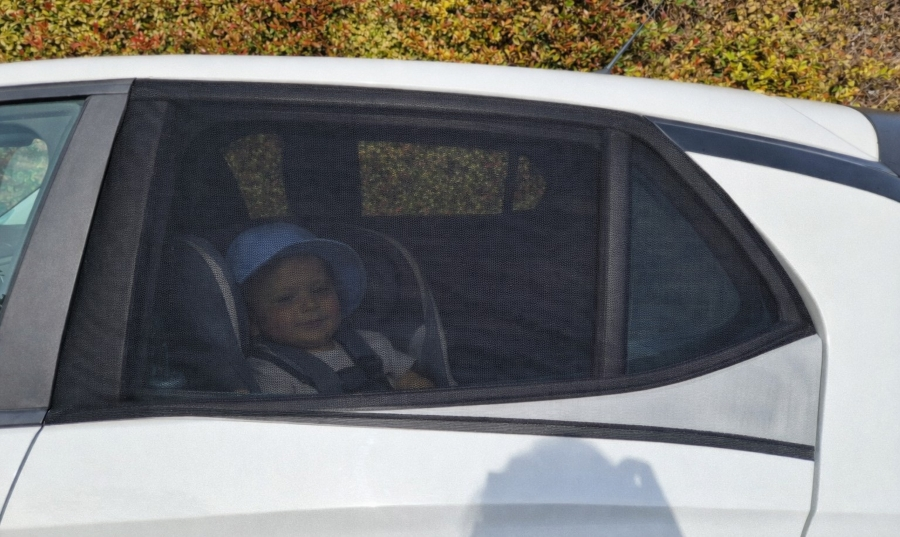
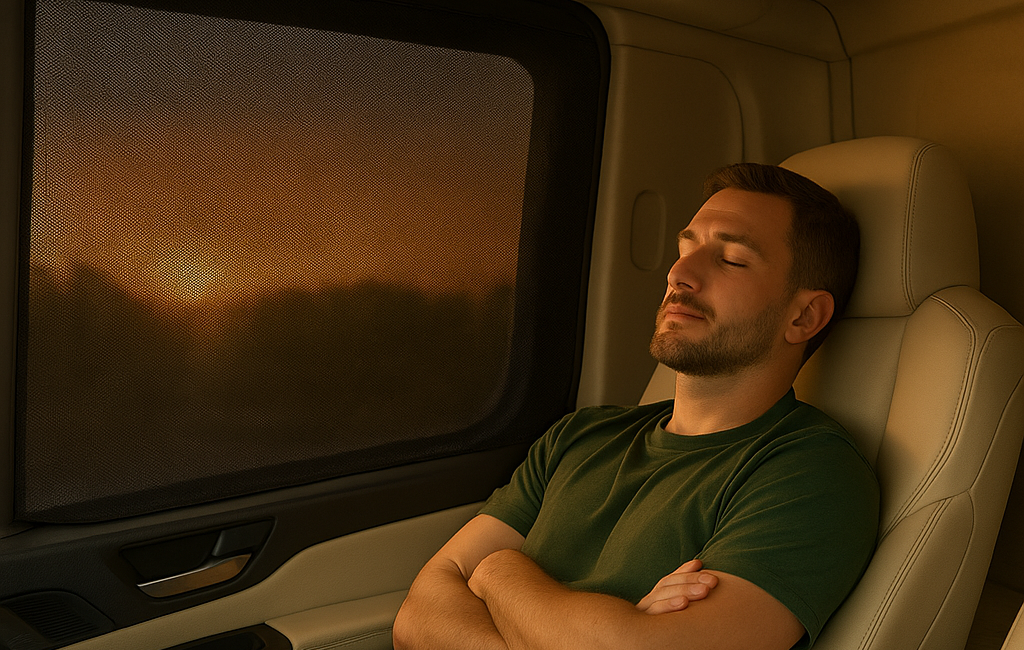
Qualizzi truck window screen shades are designed as pull-over sleeves that stretch around the window frame. They use double-layer 40D spandex mesh that blocks 96.25% of UVA radiation (with windows up). You can crack the window or leave it fully open with the Qualizzi shade in place, while still allowing air to pass through freely (with the window open, Qualizzi reduces UVA radiation by 82%). You get UV protection, reduced heat, and ventilation simultaneously.
For the bunk windows, this means you can sleep during the day without baking, without breathing stale recirculated air, and without UV radiation hitting exposed skin while you rest.
Heat Reduction in the Cab
Anyone who has come back to a parked truck in July knows what happens inside a cab with large glass windows and no shade. Interior temperatures can exceed 140 degrees Fahrenheit. The steering wheel burns your hands. The seat is unbearable. The air is thick.
Qualizzi truck shades covering the side windows reduce the amount of solar radiation entering the cab while parked. Because the double-layer mesh blocks 97% of incoming solar energy, the interior stays cooler, the A/C or APU does not have to work as hard when you start it, and the cab is livable when you return to it. Over time, less A/C load also means less fuel consumption and less wear on your APU unit.
Bug Protection at Rest Stops
Truck stops, rest areas, and rural shoulders are mosquito territory, especially in the South, the Midwest, and anywhere near standing water. If you want airflow while you sleep, you need the window open. But an open window at a rest stop in Louisiana in August means you wake up covered in bites.
The Qualizzi double-layer mesh acts as a bug screen when the window is open. The Spandex weave is tight enough to keep mosquitoes, gnats, flies, and other insects out while letting air flow through. This is not a secondary feature. For truckers who sleep in their cabs, it is one of the most practical reasons to have a mesh shade on every accessible window.
Privacy at Truck Stops
When you are parked at a truck stop and trying to sleep, change clothes, or simply have some time to yourself, the last thing you need is people walking past and looking directly into your cab. The Qualizzi mesh shade for truckers provides one-way visibility: you can see out clearly, but from the outside, the interior appears dark and opaque. It is the same principle as a screened porch. You have full awareness of your surroundings while maintaining genuine privacy inside the cab.
This matters for security, too. You can see who is approaching your vehicle without them being able to see whether you are inside, asleep, or away.
Which Size Fits a Truck? XXXL and XXXXL Explained
Most car side window sunshades are designed for sedan windows. They are too small for the windows on a Freightliner Cascadia, a Peterbilt 579, a Kenworth T680, or a Volvo VNL. This is why Qualizzi makes sizes that go far beyond what other brands offer.
| Qualizzi Size | Fits Windows Up To | Typical Truck Application | Price |
|---|---|---|---|
| XXXL | 46-50″ x 24-27″ | Standard cab side windows, many sleeper side windows | $30.97 |
| XXXXL | 50-52″ x 30″ | Large sleeper windows, extended cab panels, oversized SUV rear windows | $37.94 |
Qualizzi Sun Shades offers 9 total sizes, so if your cab has a mix of window dimensions (for example, smaller bunk windows and larger side panels), you can order different sizes for different windows. The elastic edge stretches to conform to the specific shape of each window frame, so a close size match will still provide full coverage.
To choose the right size, measure the height and width of each window you plan to cover, then match the size chart or the Qualizzi Compatibility Guides. The shade needs to be at least as large as the window opening. If you are between two sizes, go up. The elastic will pull the extra fabric snug against the frame.
Installation: 10 Seconds, No Tools, No Velcro, Clips, Adhesives, Suction Cups, or Magnets
This matters for truckers more than for most buyers. You are not going to glue anything to the glass. You are not going to stick suction cups that fall off in the heat every 30 minutes. And you do not have time to fight with a spring-loaded frame at every rest stop.
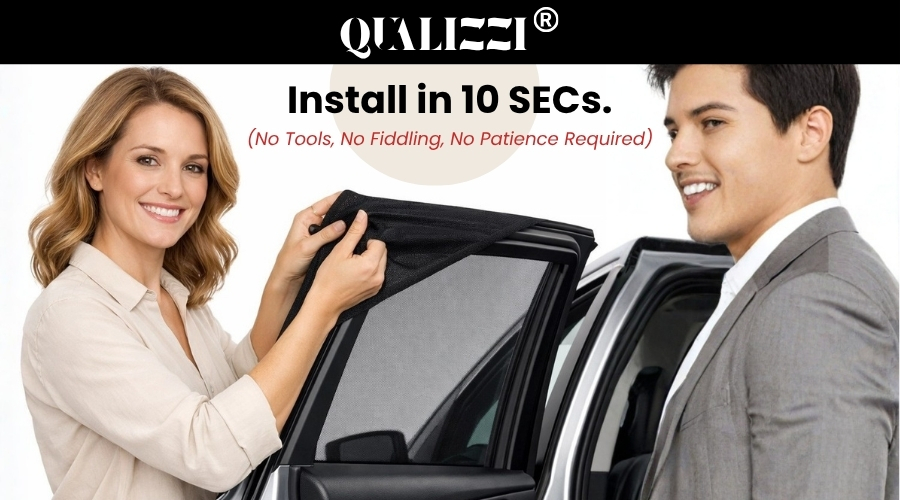
Qualizzi truck shades are installed by just sliding the double mesh over the window frame. The shade is a continuous sleeve with a reinforced elastic edge. You stretch it over the window frame from the outside, and it grips. That is it.
- Open the door or access the window from outside.
- Stretch the elastic edge of the shade over the top of the window frame.
- Pull it down and around the rest of the frame. The double-layer spandex conforms to the window shape.
- Close the door (if applicable). The shade stays in place.
Total time: Under 10 seconds per window. No tools, no clips, no adhesive, no suction cups, no magnets, no Velcro needed.
Once installed, the Qualizzi sock-style sunshade stays on. You do not remove it to roll the window up or down. You do not remove it to open or close the door. You do not remove it when you park overnight. It lives on the window frame until you decide to take it off.
To remove, simply pull the elastic edge off the frame in a couple of seconds. No residue left, no marks, no damage to the cab.
Putting It All Together: A Trucker’s Complete UV Strategy
There is no single product that solves every UV problem in a truck cab. But a two-part approach covers everything:
Part 1: While driving
- Get professional ceramic UV window film installed on your driver-side and passenger-side front windows. This blocks 99% of UVA/UVB while maintaining full optical clarity and legal compliance. One-time cost, years of protection.
- Wear UV-blocking sunglasses to protect against cataract-causing UV from all angles.
- Use sunscreen on your left arm, left hand, and left side of your neck on long-haul days. SPF 30 or higher, reapplied every two hours. This is CDC-recommended for anyone with regular UV exposure.
Part 2: While parked, resting, and sleeping
- Install Qualizzi XXL, XXXL or XXXXL slip-on shades on your sleeper cab windows and accessible side windows. These stay on permanently, block 97% of solar radiation and 96.25% of UVA radiation, allow ventilation with windows open, keep bugs out, and provide privacy at truck stops.
- The Qualizzi truck window screens also reduce interior heat buildup while parked, keeping the cab cooler for when you return and reducing the load on your APU or A/C.
Together, these two approaches cover you 24 hours a day: window film protects you while the truck is moving, and Qualizzi mesh shades protect you (and your cab) while it is not.
Ready to protect your cab?
Qualizzi Vehicle Side Window Screens are available in 9 sizes, including XXXL and XXXXL for truck cab and sleeper windows. Double-layer 40D spandex mesh blocks 97% of UV radiation. No tools, no drilling, no daily removal. Install once, drive all season.
View Qualizzi Window Shades on Amazon
Sources
- Gordon JRS, Brieva JC. “Unilateral Dermatoheliosis.” New England Journal of Medicine, 2012; 366:e25. Referenced by the Skin Cancer Foundation.
- Butler ST, Fosko SW. “Increased prevalence of left-sided skin cancers.” Journal of the American Academy of Dermatology, 2010; 63(6):1006-10.
- Skin Cancer Foundation. “UV Window Film for Your Car.”
- Skin Cancer Foundation. “UV Radiation & Your Skin.”
- Skin Cancer Foundation. “The Surprising Danger to Your Skin on Planes, Trains & Automobiles.”
- Skin Cancer Foundation. “Skin Cancer Facts & Statistics.”
- American Academy of Ophthalmology. “Sun and Your Eyes.”
- American Academy of Ophthalmology. “Eye Damage from UV Light.”
- Centers for Disease Control and Prevention. “What Are the Risk Factors for Skin Cancer?”
Frequently Asked Questions
Why do truck drivers get more skin cancer on their left side?
In the United States, the driver sits on the left side of the vehicle. The driver-side window is made of tempered glass, which allows UVA radiation to pass through. Over thousands of hours of driving, the left arm, left hand, and left side of the face receive far more UV exposure than the right side. A study in the Journal of the American Academy of Dermatology (Butler and Fosko, 2010) confirmed that left-sided skin cancers are significantly more common in American drivers.
Does the windshield protect me from UV?
Partially. Windshields are made of laminated glass, which blocks most UVA and virtually all UVB. However, your side windows are made of tempered glass, which blocks UVB but allows most UVA to pass through. UVA is the type that causes deep skin damage, aging, and contributes to cancer. Your windshield protects your face from the front, but your left side is exposed through the side window.
Can I put a Qualizzi truck shade on my front windows while driving?
No. Federal and state regulations prohibit obstructions on front windshields and front side windows, and the requirements are stricter for commercial vehicles. For UV protection on front windows while driving, we recommend professional ceramic UV window film, which blocks 99% of UV while maintaining legal visibility. Qualizzi shades are designed for rear side windows, sleeper cab windows, and all windows while parked.
What Qualizzi bug screen size fits a semi truck window?
Most standard cab side windows and sleeper windows fit the Qualizzi, XXL, XXXL, or XXXXL. Measure the height and width of each window you want to cover, and choose the size that matches or exceeds those dimensions. Qualizzi offers 9 sizes total, so you can mix sizes if your cab has different window dimensions in different locations. Check our compatibility guides.
Will a mesh shade keep bugs out if I sleep with the window open?
Yes. The Qualizzi double-layer spandex mesh acts as a fine screen when the window is open. It keeps mosquitoes, gnats, flies, and other insects out of the cab while allowing airflow. This is especially useful during mandatory rest periods at truck stops, rest areas, or rural pulloffs where standing water and vegetation attract biting insects.
How much UV does a Qualizzi truck window shade block?
Qualizzi double-layer 40D spandex mesh blocks 97% of incoming solar radiation, 96.25% UVA and UVB rays with windows closed. With windows open, Qualizzi car window mesh sun shades reduce 82% of UVA radiation. This is measured across the full window surface, not just at a single point. Because the shade covers the entire window opening from frame to frame, there are no gaps or uncovered strips where UV can reach passengers.
Can people at the truck stop see into my cab through the shade?
No. The Qualizzi mesh provides one-way visibility. From inside the cab, you can see out clearly through the mesh. From the outside, the interior appears dark and opaque, similar to how a screened porch looks from the outside. This gives you genuine privacy while resting, sleeping, or simply taking a break without feeling exposed to passersby.
Do truck drivers really need sunscreen if they are inside the cab?
Yes, especially on your left arm and left hand. Standard tempered side windows do not block UVA radiation. If you drive without UV window film on your side windows, your skin is receiving a significant UVA dose every hour. The CDC recommends SPF 30 or higher sunscreen, reapplied every two hours, for anyone with regular UV exposure. Window film on the side glass plus sunscreen is the most effective while-driving combination.
How do I clean the shade after weeks on the road?
Hand-wash the Qualizzi shade gently with mild soap and water, then air-dry it flat. Do not machine wash or wring. Because the shade stays on the truck and is made of durable spandex mesh, it typically needs cleaning only once every few weeks or when visibly dusty. On the road, a damp cloth wiped across the mesh is usually enough to remove road dust and pollen.