No products in the cart.
The Overheating Baby Problem No One Was Solving; Qualizzi® Covers the Whole Window
The Overheating Baby Problem No One Was Solving: Why Qualizzi® Covers the Whole Window, Not Just Part of It
Abstract. Qualizzi car window shades were not designed as a general car accessory that happens to work for babies. They were designed around the specific problem of babies overheating in the back seat. Every material choice, every size option, and every structural detail exists because of what babies need and what parents deal with on real drives. This article explains the design decisions behind the product, the real-world scenarios that shaped them, and why “baby-safe” means more than a label on the packaging.
Babies Were Not an Afterthought
Most car window shades are designed as a general sun-blocking product. Some block glare for the driver. Some add privacy. Some are made for camping. The word “baby” gets added to the listing title later, because it sells.
We went the other direction.
Qualizzi shades were designed from the start around a specific scenario: a baby in a rear-facing car seat, on a hot day, in the back seat of a car where the air conditioning does not fully reach. Every material, every feature, and every size option traces back to that scenario.
This article explains why.
The Back Seat Problem Nobody Talks About
When you put a baby in a rear-facing car seat, you are placing the most heat-sensitive person in the car in the worst possible position. The baby faces the rear and side windows. Direct sun hits the glass and pours into the car seat. The baby cannot turn away, cannot remove a layer of clothing, and cannot tell you they are too hot.
And here is the part most parents do not realize until it happens: the air conditioning in your car is designed for the front cabin. By the time the cooled air reaches the back seat, it has mixed with the hot air around the windows. The temperature your dashboard displays and the temperature your baby experiences can be 20 degrees apart.
We know this because we measured it. We have tested cabin temperatures in parked cars and moving cars, in multiple climates, across different vehicle types. The back seat is consistently and measurably hotter than the front, and the zone around a sun-facing window is the hottest spot of all.
That is the problem we built the product to solve. Not “sun is annoying.” Not “I want privacy.” The problem is: my baby is overheating in the back seat, and I need it to stop.
Seven Design Decisions Made for Babies
Every feature of a Qualizzi shade connects to a specific baby-related problem. Here is the logic behind each one.
1. Double-Layer Mesh: Because Baby Skin Is Not Adult Skin
Infant skin is 20 to 30% thinner than adult skin. It absorbs UV radiation faster, burns faster, and heats up faster. The Healthychildren.org recommends keeping babies under six months out of direct sunlight entirely.
A single layer of mesh reduces UV, but not enough for infant skin. Two layers of 40-denier spandex, overlapping, create a denser barrier without becoming solid. Light passes through, air passes through, but the UV that reaches your baby drops dramatically.
We chose double-layer mesh because a single layer was not safe enough for the passengers we designed the shade for.
2. Window-Down Use: Because Babies Cannot Ask for Air
An older child who feels hot will say something. A baby in a rear-facing seat cannot. By the time you notice flushed skin or fussiness from the front seat, the baby has been overheating for minutes.
The fastest way to cool the back seat is to crack the window. But with most shades, rolling the window down means removing the shade. You lose protection to gain airflow, or keep protection and trap hot air. Neither option solves the problem.
Qualizzi shades wrap around the door frame, not the glass. The window moves freely inside the mesh sleeve. Roll it down two inches or all the way. The shade stays on. UV stays blocked. Hot air escapes. Fresh air enters.
This was the first design decision we made, and every other feature follows from it. If the shade has to come off when the window goes down, it does not solve the overheating problem. It just picks which half of the problem you want to live with.
3. Full-Frame Coverage: Because the Sun Moves
A shade that covers the center of the window works at noon when the sun is high. By 3 PM, the sun has shifted. The strip of uncovered glass at the top or bottom now lets a beam of direct sunlight land exactly on your baby’s face or legs.
Parents know this feeling. You installed the shade, everything looked fine when you left the house, and twenty minutes later, the baby is squinting and crying because the sun found the gap.
Qualizzi shades cover the full window, edge to edge, top to bottom. The mesh wraps the entire door frame. There is no exposed strip at the top. There is no gap at the bottom. There is no uncovered corner. The sun angle changes during the drive, but the coverage does not.
For adults, a gap is an annoyance. For a baby who cannot move their head away from a beam of direct sunlight, a gap is the difference between a comfortable ride and a miserable one.
4. No Hard Parts: Because Things Fall on Rear-Facing Babies
A rear-facing baby sits below the window line, face up. Anything that detaches from the window falls directly toward the baby. A suction cup that pops off the glass. A magnetic strip that loses grip. A plastic clip that snaps. These are not hypothetical scenarios. Parents report them constantly.
Qualizzi shades have no suction cups, no magnets, no clips, no rigid frames, and no small detachable parts of any kind. The shade is a single continuous piece of spandex mesh held in place by an elastic band that grips the door frame. Nothing can pop off, snap off, or fall into the car seat.
We made this decision specifically because of the rear-facing seating position. A shade designed for adults can have clips and magnets because an adult can deflect a falling object. A shade designed for babies cannot assume that.
5. Nine Sizes: Because the Wrong Fit Creates Gaps
The rear side window on a Honda Civic is roughly 15 by 28 inches. On a Toyota Highlander, it is closer to 19 by 44 inches. On a Chrysler Pacifica minivan, the shape is entirely different.
A “universal fit” shade cannot cover all of these windows without compromise. On a small window, it bunches and sags. On a large window, it stretches thin and leaves the edges exposed. Both situations create gaps. Gaps let the sun through. The sun reaches the baby.
We offer nine sizes from M to XXXXL because a baby in a sedan and a baby in an SUV both deserve full coverage with no gaps. The size guide matches your window dimensions to the correct shade. A proper fit means the mesh sits flush against the glass, with uniform tension, covering every square inch of the window.
This is not a feature we added to have a longer product listing. It is a direct response to the number one reason parents return car sunshades: “It did not fit my window.”
6. 10-Second Install: Because Babies Do Not Wait
You are in a parking lot. The baby is already in the car seat. The sun is hitting the window. You need the shade on now, not in two minutes after aligning suction cups and smoothing out air bubbles.
Qualizzi shades slide over the door frame like a sock. Open the door, stretch the shade over the top of the frame, and close the door. Done. Under ten seconds, no tools, no adjustments, no re-sticking when it falls off thirty seconds later.
When the drive is over, pull the shade down and fold it into the included storage pouch. Or leave it installed. It does not interfere with the door, the window, or the seatbelt.
We designed the installation for parents who have one hand on a diaper bag and the other on a car seat carrier. If it takes longer than buckling the baby in, it is too slow.
7. Bug Mesh: Because Open Windows Have a Cost
We just told you the window needs to be down for proper ventilation. But an open window in spring and summer means mosquitoes, gnats, flies, and wasps entering the car. A baby covered in bug bites after a drive is not an improvement over a baby who overheated.
The spandex mesh acts as a window screen while the window is down. Airflow passes through. Insects do not. This is the same reason people use window screens in their homes, applied to the exact moment when your car windows are open, and your baby’s skin is exposed.
This feature was not part of the original design brief. It emerged from parent feedback in the first year: “We love that we can roll the windows down, but now bugs get in.” The mesh density that blocks UV also happens to block insects. We tested it and confirmed it. One material solves two problems.
Qualizzi Car Window Sun Shades to stop Baby overheating
We Tested It on a Real Car, Not in a Lab
You will see UV-blocking claims on every car sunshade listing. “Blocks 97% of UV.” “99% UV protection.” The numbers sound impressive, but most of them come from laboratory tests on a flat piece of fabric under controlled lighting.
A lab test does not tell you what happens in your car. It does not account for how the shade stretches over a curved window, how it sits against the glass, how the sun angle changes, or how much UV slips through the edges of a shade that only covers part of the window.
We tested Qualizzi shades differently. In a real car. On a real window. With a calibrated solar meter. In real sunlight. And we recorded the entire process on video, so any parent can watch the methodology and verify the results.
The results:
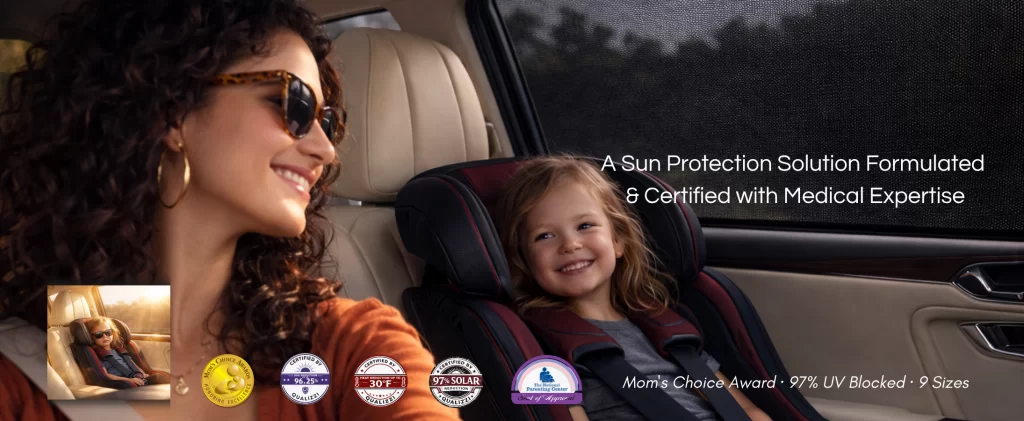
- 97% reduction of total solar radiation through the shade on the car window
- 96.25% reduction of UVA radiation, the specific wavelength that penetrates glass, damages infant skin, and drives heat buildup in the back seat
These are not fabric-sample numbers. They are installed on the car numbers. The shade was stretched over the door frame the way you would actually use it, and the meter measured what came through.
Watch the full test and comparison with the partial shades: Qualizzi UV Test: Full Coverage vs Partial Coverage
We published this because parents researching sunshades for their baby deserve to know the difference between a lab claim on a packaging sticker and a real-world measurement on a car. If a brand cannot show you their test, ask yourself what they are measuring and how.
Five Drives Every Parent Recognizes
Design decisions are abstract. These are the actual situations where they matter.
The Daily Daycare Run
Fifteen minutes each way. Morning drop-off is fine because the sun is low. But the 5 PM pickup lands directly on the rear side window. By the time you get home, the baby is red-faced, and the car seat is hot to the touch.
What the shade does: It stays installed all day. You do not remove it for drop-off and reinstall it for pickup. It is on the car, covering the window, when you buckle the baby in. The afternoon sun hits the mesh instead of the baby. Roll the window down halfway on the drive home. The back seat stays 15 to 20 degrees cooler than it would without the shade and ventilation together.
Stuck in Summer Traffic
You are on the highway. Traffic stops. The AC is running, but the car is not moving, so airflow through the vents slows. The back seat heats up. The baby starts fussing. You cannot pull over because you are in the middle lane.
What the shade does: You roll the rear window down from the driver’s controls. The shade stays on. Fresh outside air enters through the mesh, even though the car is stationary. The mesh keeps UV off the baby while the open window replaces the stagnant hot air that the barely-moving AC cannot reach. No stopping, no reaching to the back seat, no removing anything.
The Three-Hour Road Trip
Visiting family two states away. The sun changes position three times during the drive. It starts on the left side, moves overhead, then hits the right side for the last hour. A shade on one window is not enough. The baby needs both rear side windows covered, and the coverage needs to work regardless of the sun angle.
What the shade does: Full-frame coverage on both sides means the sun never reaches the baby, no matter which direction you are driving. The mesh wraps edge to edge, so there is no gap for a shifting sun angle to exploit. When the baby falls asleep and the car is quiet, you can crack both windows for cross-ventilation without waking anyone up by fiddling with suction cups.
Running Errands With a Sleeping Baby
The baby fell asleep on the way to the grocery store. You need to run inside for ten minutes. You park in the shade, but the shade might move while you are inside. You want the windows cracked for air, but you also want privacy so no one can peer in at your sleeping child. (And yes, you are taking the baby inside with you. This is about the drive to and from, not leaving a baby in a parked car.)
What the shade does: The mesh provides daytime privacy. From outside, it is difficult to see into the back seat through the double-layer spandex. From inside, the baby still has a view of shapes, light, and movement, so the nap environment is not disorienting. When you return to the car, the shade is still perfectly in place. No reattaching. No adjusting. You buckle in and drive.
Two Kids, Two Sides, Two Sun Angles
A toddler on one side, a baby on the other. Different car seat types, different window sizes, different needs. The toddler wants to see outside. The baby needs full protection from direct sunlight.
What the shade does: Both rear side windows get their own correctly sized shade. The 9-size system means the left window and right window can have different sizes if needed (some vehicles have asymmetric rear windows). Both kids get full UV protection. Both windows can be rolled down independently. The toddler can still see shapes and colors through the mesh. The baby is fully shaded without a single gap.
What “Designed for Babies” Actually Means
Many car sunshades have “baby” in the title. Here is how to tell if a product was actually designed with babies in mind versus one that was relabeled for the baby market:
- Can you use it with the window down? If not, it forces you to choose between shade and airflow. Babies overheat from both the sun and trapped air. A baby-designed shade handles both.
- Does it cover the full window with no gaps? The sun moves during a drive. A baby cannot shift position to avoid it. Full-frame coverage is not a luxury feature. It is a basic requirement for the passenger who cannot move their own head.
- Are there hard or detachable parts near the baby? A rear-facing baby sits directly below the window. Anything that pops off, unclips, or drops will land on or near the baby. A baby-designed shade has nothing that can detach.
- Is it sized for the window, or labeled “universal”? An ill-fitting shade gaps. Gaps let the sun through. A baby-designed shade comes in enough sizes that every common window shape gets a proper fit.
- Has the UV protection been tested on a real car? A lab number on a fabric swatch is not the same as a measurement on an installed shade. A baby-designed product shows you the real-world data because the stakes are higher for the smallest passengers.
These are not premium features. They are the baseline of what a car sunshade needs to do if it is genuinely designed for babies. Everything Qualizzi makes passes these five criteria because these five criteria are what we designed the product around.
Find the right size for your car: Qualizzi Size Guide | Qualizzi on Amazon
Related guides on qualizzi.com:
- Tint vs Magnetic vs Full-Coverage Mesh: Which Type Works Best for Babies?
- How to Find the Best-Fitting Car Window Shades for Babies
- Qualizzi UV Test: Full Coverage vs Partial Coverage (Video)
- Can You Roll Down Windows With Car Shades On?
Frequently Asked Questions
Are Qualizzi shades specifically designed for babies?
Yes. Every design choice, from double-layer mesh to full-frame coverage to the absence of detachable parts, was made specifically for parents driving with babies in rear-facing car seats. The product was not designed as a general car accessory and rebranded for babies. The baby scenario is the starting point of the entire design.
Why do babies overheat in the car even with the air conditioning on?
Car air conditioning cools the front cabin first. The rear seat receives less cooled air, and it also receives more direct sunlight through the side and rear windows. A baby in a rear-facing car seat sits in the hottest zone in the vehicle: directly in the path of incoming solar radiation, surrounded by heat-absorbing surfaces, with minimal airflow reaching them. The temperature around a rear-facing car seat can be 20 degrees higher than what the dashboard thermometer shows.
Can I roll down the window while the shade is installed?
Yes, fully. The shade wraps around the door frame, not the glass. The window moves freely between the two mesh layers. Roll it down two inches or all the way. The shade stays on, UV stays blocked, and fresh air reaches the back seat. This is the core feature that lets the shade address both causes of overheating at once: solar radiation and trapped hot air.
How much UV do Qualizzi shades actually block?
In our real-world test, conducted on an actual car with a calibrated solar meter and published on video, Qualizzi shades blocked 97% of total solar radiation and 96.25% of UVA radiation. These are not lab numbers from a fabric swatch. They are measurements from a shade installed on a car window the way you would actually use it. You can watch the full test on our UV test page.
What is the difference between lab-tested and real-world UV results?
Lab tests measure a flat piece of fabric under controlled lighting. They do not account for stretch, fit, sun angle, or coverage gaps on an actual window. A shade can claim 99% UV blocking in a lab and still let significant UV reach your baby if it only covers part of the window or gaps along the edges. Real-world testing on a car gives you the number that actually matters: how much UV reaches your baby through the installed shade, gaps included.
Why does Qualizzi offer 9 sizes instead of a universal fit?
Because a shade that does not fit correctly leaves gaps, and gaps let sun reach the baby. Rear side windows range from roughly 13 by 22 inches on small sedans to 21 by 48 inches on large SUVs. A single “universal” shade cannot cover that range without bunching on small windows or stretching too thin on large ones. Nine sizes mean the mesh sits flush against your specific window, with no gaps, no sagging, and no excess fabric interfering with the rearview mirror.
Will a Qualizzi shade fall onto my rear-facing baby?
No. There are no suction cups, magnets, clips, or rigid components anywhere in the design. The shade is a continuous piece of spandex mesh held by an integrated elastic band that grips the door frame. Nothing can pop off, snap loose, or drop into the car seat. This was a deliberate design choice made specifically because rear-facing babies sit directly below the window and cannot deflect falling objects.
Can bugs get in if the window is down with the shade on?
The double-layer spandex mesh blocks insects the same way a window screen does. Air passes through. Mosquitoes, gnats, flies, and wasps do not. This means you can keep the window down for ventilation during spring and summer drives without exposing your baby to bug bites.
How do I know which size to order?
Measure the height and width of your rear side window, including the door frame. Compare your measurements to the Qualizzi size chart. If you fall between two sizes, choose the larger one for fuller coverage. If you are unsure, contact us and we will help you choose. We also offer free replacements if you order the wrong size.
How long does installation take?
Under ten seconds. Open the car door, stretch the shade over the top of the door frame, close the door. No tools, no adhesive, no alignment. When you want to remove it, pull the shade down with one hand and fold it into the included storage pouch. Most parents leave the shade installed between drives rather than removing it each time.