No products in the cart.
Real-World Qualizzi® UV Test on Car Sun Shades: What We’ve Learned About Solar Radiation, Coverage and Visibility
Abstract
This article explains why Qualizzi® began testing its car window sunshades in real vehicles instead of relying only on fabric-based laboratory claims. It compares full-coverage mesh sunshades with partial designs, discusses why coverage matters as much as fabric performance, and includes a follow-up in-car meter update showing how different window and shade conditions affected UV readings inside the vehicle.
Contents
- Why Qualizzi® started testing its mesh car window sunshades in real cars — and why fabric-only lab claims don’t tell the whole story
- Why Qualizzi® started questioning the usual claims
- So Qualizzi® bought its own meters and started testing
- What the Qualizzi UV test showed
- The problem is not just the fabric. It is the coverage.
- What happened when we compared full coverage vs partial coverage
- Full Coverage vs Partial Sunshades: What Actually Makes the Difference
- Why the usual “99% UV blocking” claim can be technically true and still misleading
- Why Most UV Claims Are Misleading
- Car glass helps, but it does not solve the problem
- And what about visibility?
- What we learned from all this
- Update: Latest Meter Results From Our Follow-Up In-Car Test
- Where Qualizzi® goes next
- Can you roll down your windows with Qualizzi® sunshades?
- Final takeaway
- Final Verdict
- Frequently Asked Questions
Do Car Window Sunshades Really Make a Difference?
Short answer: yes, but how much depends entirely on the type.
Not all car window sunshades deliver the same level of protection. The difference between types is not small, and the claims on most packaging do not reflect what actually happens inside a vehicle.
Here is what Qualizzi measured in a real car, under real sunlight, using a UV meter placed where a passenger sits:
- No protection, window down: 8.0 UVI (full exposure)
- Window up, no sunshade: 0.9 UVI (88.75% reduction from glass alone)
- Qualizzi full-coverage mesh shade, window down: 1.4 UVI (82.5% reduction)
- Qualizzi full-coverage mesh shade, window up: 0.3 UVI (96.25% reduction)
So yes, sunshades make a measurable, significant difference. But the size of that difference depends on three things most brands never talk about:
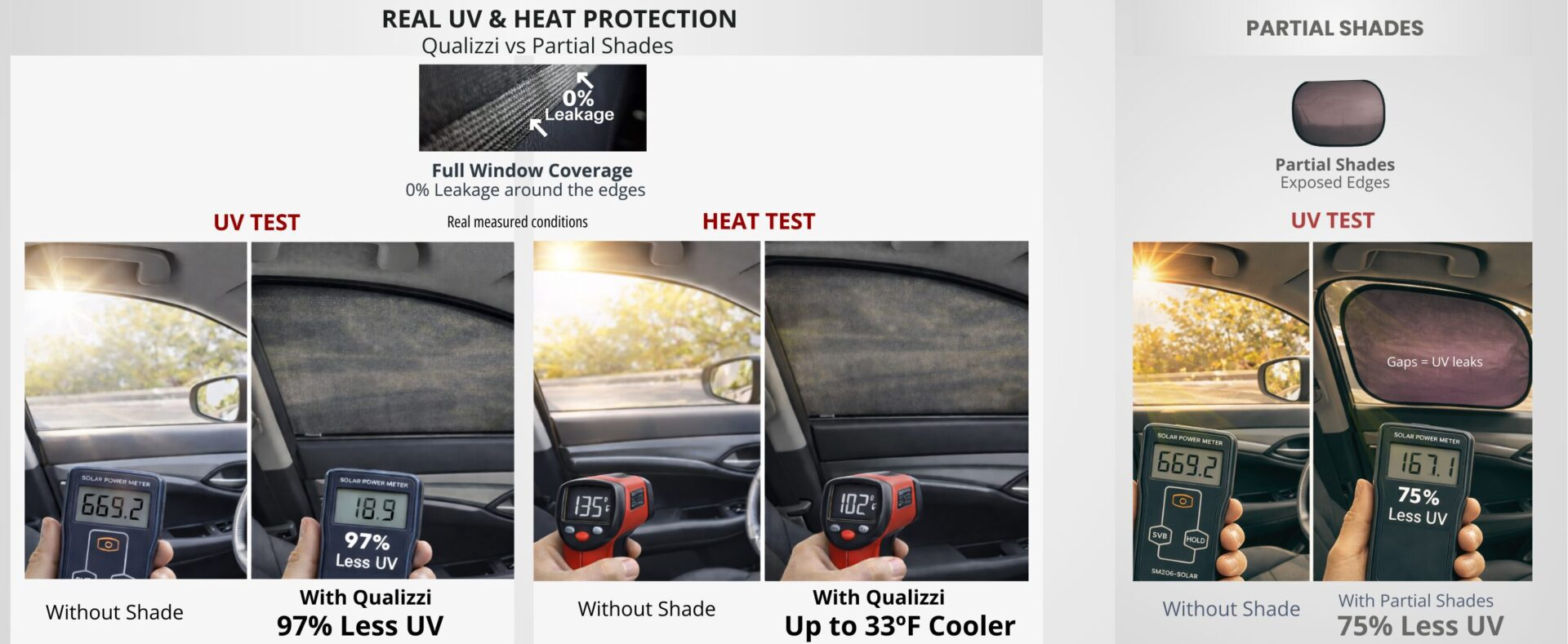
1. Coverage matters more than fabric ratings. A partial shade may block UV where the material sits, but sunlight still enters through uncovered gaps around the edges. In our side-by-side test, a cling-style partial shade reduced exposure by about 75%, while Qualizzi’s full-coverage design reached 97% under the same conditions. The fabric was not different. The coverage was.
2. Closed glass already blocks most UVB, but not UVA. Standard side windows filter out most UVB rays but let 60 to 70% of UVA pass through. UVA is the wavelength responsible for long-term skin aging and cumulative damage. A sunshade that covers the full window adds a second barrier where glass alone falls short.
3. The real benefit is cumulative, not one-trip. A single 20-minute drive may not feel dangerous. But years of daily commuting, school pickups, and road trips add up. Children, babies, the elderly, and anyone sitting next to a side window accumulates exposure over time. A full-coverage shade reduces that accumulation on every single drive.
The rest of this article explains how we tested, what we compared, and why most UV claims in this category are misleading. But if you came here asking whether sunshades are worth it, the data says yes, as long as the shade actually covers the whole window.
Why Qualizzi® started testing its mesh car window sunshades in real cars — and why fabric-only lab claims don’t tell the whole story
For years, customers kept asking the same question, and that is what started this Qualizzi UV test:
How much radiation do these car window sunshades actually block?
At first, we did what most brands probably do. We looked around, checked what other companies were claiming, and tried to make sense of the numbers already out there.
That is when we noticed something interesting.
Many partial sunshades, especially static cling models, were advertising very high UV-blocking figures. Some claimed to block 99% or even 99.9% of UV rays. On paper, that sounded impressive. But the more we looked at those claims, the less convinced we were that they reflected what happens in a real car, with real sunlight, real windows, and a real child sitting next to the door.
So Qualizzi® decided to test things for itself.
To better understand how coverage affects real exposure, we recorded the following real-world test.
Real-world test comparing full coverage Qualizzi® sunshades vs partial designs, measuring solar radiation exposure inside a vehicle.
You can see our full-coverage mesh sunshades here:
Qualizzi® official website
and here:
Qualizzi® on Amazon.
Why Qualizzi® started questioning the usual claims
Qualizzi® sunshades are different from most partial window shades. They are full-coverage mesh shades that slip over the whole upper door frame, like a sock. They are also double-layered in actual use, because the mesh sits on both sides of the window opening once installed.
When we first explored lab testing, we quickly ran into a problem.
The preliminary testing we looked at focused on the fabric itself. A lab places the material under controlled light, measures what passes through it, and returns a number. That may be useful for testing a textile. But it did not reflect how a Qualizzi® sunshade works in real life.
A Qualizzi® sunshade is not used as a single flat layer in isolation. It is installed on a car door. It wraps the window area. It creates full coverage. And in actual use, sunlight does not come through a perfectly centered beam in a laboratory. It comes from angles, shifts through the day, and hits different parts of the car depending on the position of the sun.
We asked whether the product could be tested the way it is actually used. That was not really how the lab worked. They were testing one layer of fabric under their standard setup, not a sunshade installed on a vehicle.
At that point, we stopped.
Not because testing does not matter. The opposite. We stopped because we realized that the standard lab-style number was not going to answer the real question customers were asking.
The real question was never, “How does one layer of fabric behave under an artificial lamp?”
The real question was:
What happens inside an actual car?
So Qualizzi® bought its own meters and started testing
After seeing the same impressive percentages repeated across the market, Qualizzi® decided to stop guessing and start measuring.
We bought our own equipment and began doing comparative tests ourselves. From the beginning, we were interested in two separate things: radiation exposure and heat. Those are not the same issue, and they should not be mixed together, so this article focuses only on the real-world solar radiation testing we have completed so far.
For the work already done, Qualizzi® used a Jeankak solar radiation meter for comparative solar readings and a Wintact infrared thermometer for separate heat and surface temperature testing.
We have now also purchased an AquaHorti UV meter for a more specific UVA and UVB phase, but that part of the testing is still in progress and will be covered in a separate article once it is complete. (We finalized this test and our findings are updated below).
That distinction matters to us. We would rather be precise about what has been measured already than blur different kinds of measurements together.
What we found very quickly was that outdoor testing is messy in a way laboratory numbers are not.
Solar radiation readings change depending on time of day, cloud cover, season, sun angle, and whether the vehicle is in full sun or partial sun.
That matters because some percentages can look lower or higher depending on the baseline outside the car.
For example, if the sky is cloudy and solar radiation levels are already low outside, then the reduction measured inside the vehicle may look less dramatic as a percentage. But that does not mean more harmful radiation is getting through in absolute terms. It simply means the starting level was already low.
On the other hand, under stronger sun, especially around midday in clear conditions, the reduction becomes much more meaningful, because that is when exposure is highest and protection matters most.
So instead of pretending there is one universal number that applies to every place, season, and hour, Qualizzi® chose a more honest benchmark: a sunny midday test, under typical spring conditions, as a practical midpoint between winter and peak summer.
That is the basis for the figures we use so far.
What the Qualizzi UV test showed
In those conditions, Qualizzi® full-coverage mesh sunshades reduced solar radiation exposure by roughly 97%.
That result surprised us at first.
Not because 97% is low. It is not. But because it was different from the 99% or 99.9% claims we kept seeing elsewhere.
So we looked more closely at why the numbers were different.
And the answer, as far as we can see, is simple.
Those very high claims are usually about the material itself, measured in idealized conditions. They are not necessarily measuring the total radiation exposure that reaches a passenger inside a real vehicle.
That distinction matters more than most people realize.
The problem is not just the fabric. It is the coverage.
This is the point where real-world testing changed the whole conversation for us.
A partial sunshade may block a lot of radiation in the exact area where the material is placed. Fine. We do not dispute that. If you test only that covered section, you may get a very strong result.
But cars are not made of one perfectly covered square.
And once that happens, the impressive lab number stops meaning what people think it means.
Because a child sitting next to the window is not only exposed to the portion directly behind the fabric. They are exposed to the whole window area and the angles at which sunlight enters the vehicle.
That is exactly why Qualizzi® started doing side-by-side comparisons.
What happened when we compared full coverage vs partial coverage
When we compared our full-coverage Qualizzi® mesh shade with a cling-style partial shade, the difference was not really about whether the fabric in the middle reduced radiation. It did.
The real difference was what happened around it.
With the partial shade, radiation still entered through the uncovered areas of the window. In other words, the protection was strong where the material existed, but incomplete where the window remained open to direct sunlight.
That made the real-world reduction much lower than the kind of 99% headline consumers are led to expect.
In our comparative testing, the cling-style option reduced solar radiation exposure by around 75% overall in the kind of angled, real-life conditions that matter inside a car.
That is still a reduction. It is not nothing. But it is a very different proposition from a near-total block claim.
And that is the whole issue.
To better understand how coverage affects real exposure, we recorded the following real-world test.
Real-world test comparing full coverage Qualizzi® sunshades vs partial designs, measuring solar radiation exposure inside a vehicle.
Full Coverage vs Partial Sunshades: What Actually Makes the Difference
- Full coverage sunshades: Cover the full window area, reduce direct sunlight from multiple angles, improve privacy, and help reduce bugs when the window is rolled down.
- Partial sunshades: May use decent fabric, but still allow sunlight, glare, and heat to enter through uncovered gaps around the window.
- What matters most in real use: Coverage, fit, and whether the shade protects the actual exposed glass area, not just the center of the window.
Why the usual “99% UV blocking” claim can be technically true and still misleading
This is where a lot of sunshade marketing becomes slippery.
A brand may say its material blocks 99% of UV. That can be technically true in a narrow sense. But people reading that claim usually interpret it as:
“This product will protect me from 99% of radiation inside the car.”
Those are not the same thing.
If a sunshade covers only part of the window, then the uncovered parts still let sunlight through. At that point, what matters is not just the performance of the fabric, but the performance of the whole installed product.
And in the real world, the installed product includes gaps, corners, window shape, sun angle, and passenger position.
That is why Qualizzi® ended up caring less about isolated fabric numbers and more about actual exposure inside the vehicle.
Why Most UV Claims Are Misleading
Many brands advertise “99% UV blocking,” but these claims are based on laboratory fabric tests, not real-world use. In practice, sunlight enters through uncovered areas, making coverage more important than fabric ratings alone.
Car glass helps, but it does not solve the problem
Another thing people often miss is that the car window itself already reduces part of the incoming radiation. So yes, even uncovered glass is not the same as an open hole with no barrier at all.
But that does not mean side-window exposure stops being relevant.
If radiation still comes through the uncovered parts of the window, then those gaps still matter. They matter especially for children and babies sitting close to the glass, where exposure is concentrated and repeated over long drives.
So the question is not whether the glass helps.
It does.
The question is whether the sunshade adds consistent, full-area protection where it is actually needed.
And what about visibility?
This is another reason Qualizzi® wanted to test and observe the product in real use instead of relying only on abstract claims.
One of the big trade-offs in this category is that some products may block a section of sunlight very aggressively in the area they cover, but at the cost of being more obstructive, more limited in coverage, or less usable in day-to-day life.
With Qualizzi® full-coverage mesh sunshades, we kept seeing the same balance in real use: the window area remained covered, privacy improved, and outward visibility from inside the vehicle was still good and usable.
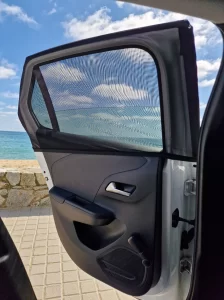
High visibility with Qualizzi Sun shades
That matters.
Because protection is only one part of the real-world equation. A sunshade also has to be livable with. It has to feel practical for passengers. It has to allow people inside the car to still see out normally enough during everyday use. And it has to do that without leaving the obvious uncovered gaps that partial shades leave around the edges.
That is one of the reasons Qualizzi® has always considered coverage and visibility together, not as separate issues.
What we learned from all this
After all the preliminary lab questions, the false starts, and the real-world testing, the conclusion for Qualizzi® is straightforward:
Coverage matters as much as fabric performance, and often more.
A sunshade that performs brilliantly in the middle but leaves exposed gaps around the edges can still allow substantial radiation into the car.
A full-coverage mesh shade like Qualizzi® may not produce the flashiest theoretical headline when compared to isolated textile lab claims, but in actual vehicle use, it provides something far more important:
consistent protection across the whole window area
That is what our testing kept showing, again and again.
Update: Latest Meter Results From Our Follow-Up In-Car Test
Since publishing this article, we completed a follow-up comparative in-car reading using the AquaHorti AH-UVCBA UV light meter, which the manufacturer describes as a meter for UVB UV index, UVC UV index, and UVA irradiance readings, with additional UVC/UVA distribution data in W/m². According to the product description, it can be used for sunlight and UVB sources, while its UVC irradiance function is not intended for sunlight. A photo of the meter used in our test is included below.
This follow-up was not designed as a laboratory fabric certification test. It was a practical interior comparison test intended to compare real-use conditions inside the vehicle using the same meter setup across different window and shade conditions.
In the highest reading we recorded on video, the results were as follows:
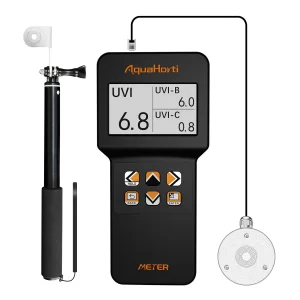
- 8.0 UVI — window down, no protection
- 0.9 UVI — window up, no sunshade
- 1.4 UVI — Qualizzi® sunshade installed, window down
- 0.3 UVI — Qualizzi® sunshade installed, window up
Using the most exposed condition as the baseline, this means:
- Window up, no sunshade: 88.75% reduction
- Qualizzi® sunshade + window down: 82.5% reduction
- Qualizzi® sunshade + window up: 96.25% reduction
(AquaHorti AH-UVCBA meter used in our follow-up comparative in-car UV reading.)
One important point became very clear in this follow-up test: closed glass blocked more UV than the sunshade used with the window open. That does not weaken the result. It simply reflects the fact that closed glass adds another barrier.
What matters in practice is that the Qualizzi® sunshade still delivered a strong reduction while allowing the window to remain open for airflow, daytime privacy, and reduced bug entry. That is a different real-world use case from driving or resting with the glass fully closed.
This update also reinforces an important technical distinction: material ratings such as UPF, or fabric-only claims, are not the same thing as real in-car exposure readings taken under actual use conditions. Our goal here is not to blur those measurements together, but to document what happened inside an actual vehicle under the same comparative setup.
What Sun Damage Actually Does to Your Car Interior (and What Stops It)
Most people think about sunshades as protection for passengers. They are. But the same UV and heat that affect your skin also break down nearly every surface inside your car.
Here is what happens over time when side windows are left unprotected:
Dashboard cracking. Prolonged UV exposure dries out vinyl and plastic compounds, causing them to become brittle and crack. This is accelerated by heat, which is why dashboard damage is almost always worse on the side facing the sun.
Upholstery fading. Fabric seats lose color unevenly. Leather dries out, stiffens, and eventually splits. The fading pattern typically follows the window line, which confirms that side-window exposure is the cause, not general aging.
Steering wheel and trim degradation. Rubber and soft-touch surfaces become sticky, discolored, or chalky after repeated UV and heat cycles.
Infotainment screen glare and aging. Screens exposed to direct sunlight for extended periods can develop reduced contrast and discoloration over time.
The reason this damage concentrates on one side of the car is the same reason skin damage does: standard side glass lets most UVA through. UVA does not cause immediate visible burns the way UVB does, but it breaks down materials slowly and persistently.
What actually stops it:
- Full-coverage window shades reduce both UV and solar heat reaching interior surfaces. In our testing, Qualizzi shades reduced UV exposure by 96.25% with the window up, which means surfaces behind the shade receive a small fraction of the radiation they would otherwise absorb.
- Windshield reflectors help with the dashboard and front seats, but do nothing for side-window exposure.
- Parking in shade helps when available, but does not protect during driving.
- Leather and vinyl conditioners slow degradation but do not prevent it. They treat symptoms, not the cause.
- Window tint reduces some UV but varies by quality, and many states regulate how dark side windows can be, limiting the protection you can legally apply.
The most effective approach combines more than one of these. But for the side windows specifically, where the factory glass offers the least UV protection, a full-coverage shade is the most practical first step.
If you are already using Qualizzi shades for your children or pets, they are doing double duty: protecting your passengers and your car’s interior at the same time, on every drive.
Where Qualizzi® goes next
At this point, Qualizzi® has already completed comparative real-world solar radiation testing and separate heat testing. The next phase is more specific UVA and UVB measurement using the AquaHorti UV meter we have now added to the process.
We are doing that because we want the next stage to be more precise, not because the current results were meaningless. On the contrary, the current tests already made one thing very clear: what happens in a real car depends heavily on coverage, angle, and real installation, not just on a laboratory claim about a fabric sample.
So the experiment is still ongoing.
But the pattern is already clear.
So far, the Qualizzi UV test has reinforced one central point: in real vehicles, full coverage matters more than isolated fabric claims.
*UPDATE NOTE – 3/3/2026: The follow-up in-car meter results referenced earlier in this article have now been added above. Our goal remains the same: to document real-world sunshade performance as clearly and honestly as possible, using practical comparisons that reflect how these products are actually used inside the vehicle.
Can you roll down your windows with Qualizzi® sunshades?
One of the most practical differences we noticed during the Qualizzi UV test had nothing to do with lab numbers or isolated measurements. It had to do with how the product behaves in real daily use.
Because Qualizzi® sunshades fully cover the window frame like a flexible mesh sleeve, you can still roll the window down while the sunshade is installed.
This creates something that most partial sunshades simply cannot offer at the same time:
- airflow and ventilation inside the car
- continued sun protection
- privacy from the outside
- reduced entry of insects compared to open windows
With partial sunshades, lowering the window usually removes the protection entirely or leaves large gaps. With Qualizzi®, the mesh remains in place, which allows air to pass through while maintaining coverage across the whole window area.
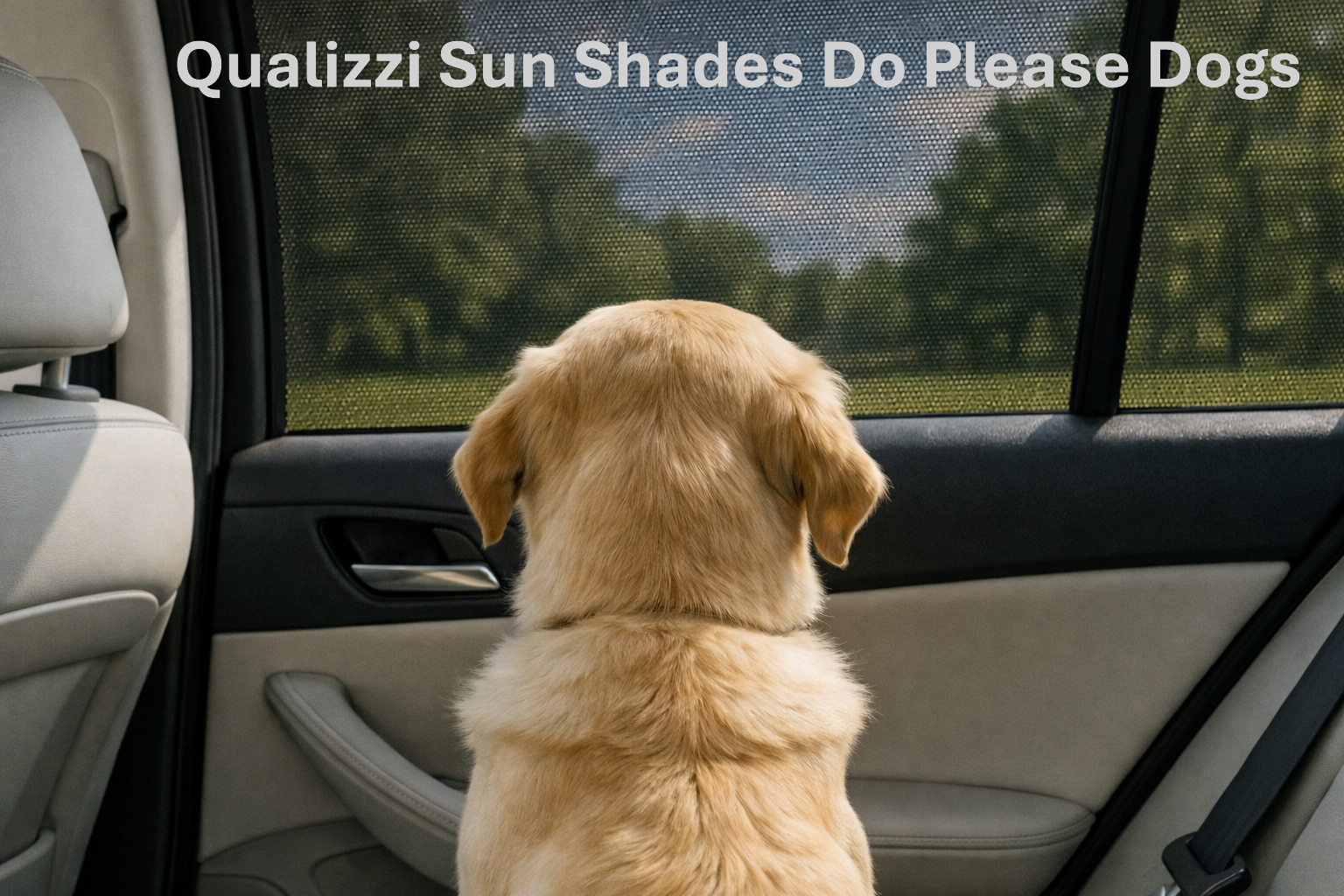
This is especially useful during road trips, camping, or when passengers — including children or pets — need fresh air without being directly exposed to sunlight.
In real-world use, this combination of coverage, airflow, and usability turned out to be just as important as the radiation reduction itself.
Final takeaway
If you are comparing car sunshades, do not just ask:
How much does the fabric block?
Ask this instead:
How much of the actual window is protected once the product is installed?
Because that is where the real difference is.
And based on everything Qualizzi® has tested so far, that is the difference between a product that looks strong on paper and one that protects more consistently in the car.
Final Verdict
UV protection is not just about fabric quality. It’s about coverage. Even the best material cannot block sunlight that enters through gaps. That’s why full-coverage sunshades like Qualizzi® provide a more effective real-world solution.
To see the full-coverage design in more detail, visit
Qualizzi®
or view the product directly on
Amazon.
Frequently Asked Questions
Why does UV testing matter for car window sunshades?
UV testing helps show whether a sunshade reduces real in-car exposure, not just how its fabric performs on its own. That matters because coverage, edge gaps, and the type of glass already in the vehicle can all affect how much UV actually reaches passengers.
Do full-coverage car window shades work better than partial shades?
They can in real use, because a full-coverage design protects a larger portion of the window opening. Material claims alone do not always reflect total in-car protection if part of the window area remains exposed. This article focuses on that real-world difference between full coverage and partial coverage.
Does a closed car window block more UV than a sunshade with the window open?
In our follow-up in-car test, yes. The closed glass reduced the UV reading more than the sunshade used with the window open. However, the sunshade still delivered a strong reduction while allowing airflow, daytime privacy, and reduced bug entry.
How much reduction did the Qualizzi® sunshade achieve in the follow-up test?
Using the most exposed condition as the baseline, the reading was reduced by 82.5% with the sunshade installed and the window down, and by 96.25% in the most protected setup with the sunshade installed and the window up.
Does this test prove the same thing as a UPF rating?
No. A practical in-car reading test is not the same as a laboratory fabric certification test. Material ratings such as UPF describe how a fabric performs under standardized test conditions, while in-car readings show what happened inside a real vehicle under a specific comparative setup.
Can UV exposure through car windows contribute to skin damage over time?
Yes. Medical and skin-cancer sources note that UVA can pass through side windows and contribute to long-term skin damage. Several sources also point to asymmetric skin damage or increased skin-cancer burden on the side of the body closer to the window, consistent with driving exposure patterns.
Is the Qualizzi® sunshade meant to outperform closed glass?
No. Closed glass can block more UV in some conditions. The purpose of the Qualizzi® sunshade is different: it helps reduce UV while still allowing the window to remain open for ventilation, privacy, and comfort.
What type of test was used for the follow-up measurements?
The follow-up was a comparative in-car reading using the AquaHorti AH-UVCBA UV light meter. It was intended as a practical comparison of different real-use conditions inside the vehicle, not as a laboratory certification test.
Q: Do car window sunshades protect your car interior from sun damage?
A: Yes. UV and heat that pass through side windows cause dashboard cracking, upholstery fading, leather aging, and surface degradation over time. A full-coverage sunshade like Qualizzi reduces the UV reaching interior surfaces by up to 96.25%, slowing this damage significantly on every drive.
Q: How do I protect my car interior from sun damage?
A: The most effective combined approach is: use full-coverage side window shades to block UV during driving, use a windshield reflector when parked, park in shade when available, and condition leather or vinyl surfaces periodically. For side windows specifically, a full-coverage shade provides the most protection because standard side glass lets most UVA through.