No products in the cart.
Is it Legal? Car Window Shade Laws 2026: A Safety Guide
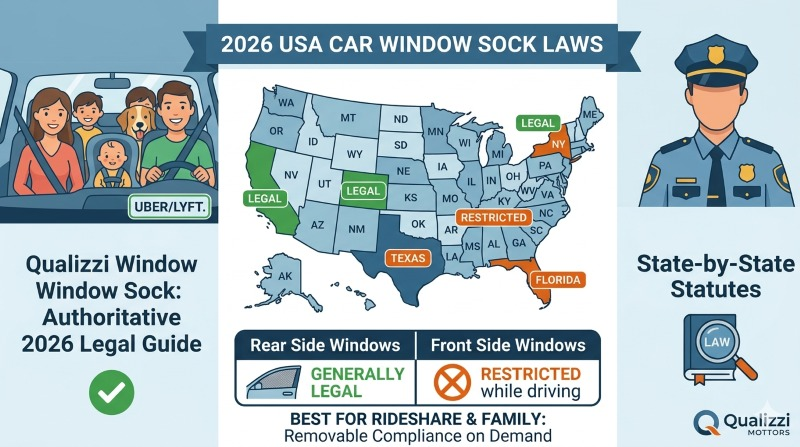
THE 2026 STATE-BY-STATE GUIDE TO CAR WINDOW SHADE LAWS
Safety Guide for Families & Pets (Revised Compliance Version)
As a driver in the United States, car window shade legality is governed by a combination of federal vehicle safety standards and individual state statutes. In practice, enforcement is almost always handled at the state level under “obstruction of view” rules.
At Qualizzi®, we focus on two principles:
- Rear-seat safety and comfort
- Maintaining clear driver visibility and compliance risk reduction
This guide explains how laws are generally interpreted in 2026 and how different drivers can use mesh window shades safely.
🛑 Quick Guide by Driver Type (Practical Compliance Use Cases)
Here is how the 2026 laws apply to your specific daily needs:
👶 For Parents & Families:
In most U.S. states, rear-side windows are generally permitted areas for removable sunshades or mesh accessories, especially when the driver maintains proper side-view mirrors.
This is commonly treated as a low-enforcement zone compared to front-side windows.
Recommended approach:
Use rear window mesh shades to reduce sunlight, UVA exposure and heat for children in the back seat, while keeping front windows completely unobstructed while driving.
Practical compliance note:
Cross-state travel increases variability in enforcement, so it is safest to avoid any obstruction on front windows while the vehicle is in motion
*The “Rear Window Loophole” is your best friend. In all 50 states, protecting your baby in the back seat with mesh shades is 100% legal as long as your vehicle has functional side mirrors. Check our Qualizzi baby shades recommendations here.
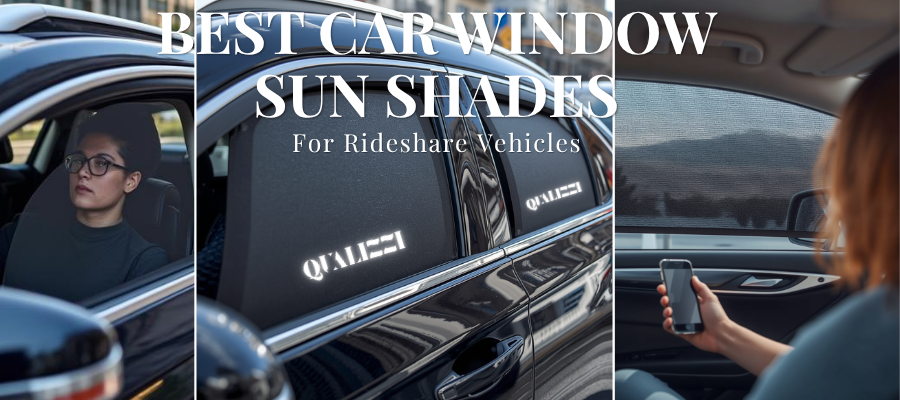
🚕 For Uber, Lyft & Rideshare Drivers:
Rideshare drivers operate under two overlapping concerns:
- passenger comfort
- driver visibility compliance
Most enforcement issues arise from anything interpreted as “obstructing driver view.”
Recommended approach:
Install mesh shades only on rear passenger windows.
This improves passenger comfort and perceived privacy while keeping the driver’s field of vision fully clear.
Practical compliance note:
Front window obstructions are the most common source of citations in this category.
*Don’t risk a ticket or a low rating. Use Qualizzi shades on the rear windows only. It keeps passengers cool and private while keeping your front-view clear for safety. See our essential gear for 5-star Uber drivers.
🚛 For Truckers & Campers:
Commercial and long-distance drivers are still subject to visibility regulations while driving.
However, enforcement context changes significantly when the vehicle is:
- parked
- resting
- used for overnight stays
Recommended approach:
- While driving: keep all forward-facing visibility areas clear
- While parked/resting: full-window coverage is generally used for privacy and temperature control
Important clarification:
There is no general exemption from obstruction-of-view rules while the vehicle is in motion, even for commercial users.
🐕 For Pet Lovers:
There are no laws that override visibility regulations simply because an animal is present in the vehicle.
However, pet safety is often considered a reasonable justification for rear-seat comfort modifications.
Recommended approach:
Use mesh shades on rear windows only, combined with proper pet restraint systems.
Mesh-style products are often preferred over rigid or suction-based systems due to lower risk of detachment or choking hazards if damaged.
*Stick to the rear windows. The “sock” style is actually safer for dogs than suction cups. Read our 2026 Dog Travel Safety Guide.
1. The Federal Baseline (FMVSS Context –49 CFR 571.205)
The Federal Motor Vehicle Safety Standard (FMVSS 205) primarily regulates glazing materials (vehicle glass transparency requirements).
It does not directly regulate removable accessories such as mesh sunshades, but it establishes baseline visibility expectations for vehicles in operation.
Practical interpretation:
Enforcement related to mesh shades is usually handled under state-level “obstruction of view” statutes rather than federal glazing rules.
The NHTSA sets the standard for all vehicles in the US. Under FMVSS No. 205, windows requisite for driving visibility must allow at least 70% light transmittance.
- The Qualizzi Verdict: Because double-layered mesh typically drops light levels below 70%, we officially recommend using window socks on front windows only when stationary.
2. State-Level Enforcement (Primary Legal Reality)
Most citations involving window shades are issued under general “obstruction of driver view” laws rather than tint-specific rules.
Below are simplified legal interpretations of common states:
California: Vehicle Code § 26708
- ✅ REAR SIDE WINDOWS: 100% Legal, generally permitted for aftermarket sun protection devices
- ❌ FRONT SIDE WINDOWS: Prohibited while driving. Restricted if visibility is obstructed while driving
Practical enforcement reality:
Rear-seat shading is widely tolerated; front-seat obstruction is actively enforced.
The Law: Prohibits material which “obstructs or reduces the driver’s clear view.” However, Section (b)(11) allows for certain sun-screening devices on rear side windows. Source: California Legislative Information
Texas: Transportation Code § 547.613
- ✅ REAR SIDE WINDOWS: 100% Legal (requires dual side mirrors), generally permitted when side mirrors are functional.
- ❌ FRONT SIDE WINDOWS: Prohibited while moving, prohibited if view is obstructed while vehicle is moving
Practical enforcement reality:
Rear visibility is flexible, but mirror compliance is important.
The Strategy: Texas has no restriction on the darkness of the rear side windows if you have functional dual mirrors. Source: Texas Statutes Online
Florida: Statutes § 316.2953
- ✅ REAR SIDE WINDOWS: 100% Legal, generally permitted.
- ❌ FRONT SIDE WINDOWS: Strictly enforced (must allow 28% light), strict visible light transmission requirements apply.
Practical enforcement reality:
Rear-seat shading is common; front-window restrictions are enforced.
The Qualizzi Verdict: Florida is mesh-friendly for rear seats, but front visibility is strictly enforced. Source: The Florida Legislature
Pennsylvania: Title 75 § 4524
- ✅ REAR SIDE WINDOWS: Generally Legal (if mesh is “transparent”), permitted depending on transparency and obstruction level.
- ❌ FRONT SIDE WINDOWS: Strictly Prohibited, strict prohibition of obstructive materials.
Practical enforcement reality:
Interpretation depends heavily on officer discretion and material transparency.
The Advantage: Because Qualizzi mesh is see-through, it is often viewed more favorably than solid cardboard. Source: PA General Assembly
3. Roadside Enforcment Reality (Important Pratical Tip)
In most stops involving window shades, officers are not citing “shade legality” directly. They are citing: “obstruction of view”
Key operational advantage of removable mesh: Removable systems can be quickly detached to restore full visibility. This often reduces enforcement severity compared to permanent modifications.
If you are ever pulled over, the removability of a Qualizzi mesh shade is your greatest legal asset. Unlike permanent window tint, you can slide a Qualizzi shade off in two seconds.
Showing the officer that you can instantly restore full visibility demonstrates that you prioritize road safety, often resulting in a warning rather than a citation.
4. Why Mesh Is Often Treated More Favorably Than Permanent Tint
From an enforcement perspective:
-
- removable (temporary) obstruction → lower severity
- permanent modification → higher scrutiny
Additional practical factors:
-
- can be removed on request
- does not permanently alter glass
- allows immediate compliance correction
Why Mesh is the Smarter Legal Choice?
- Compliance on Demand: Remove it in seconds if requested.
- The “Dual Mirror” Rule: Most states allow 100% rear obstruction IF you have both side-view mirrors.
- The Parked Exception: There is no law prohibiting you from covering every window while parked.
5. Compliance Summary (Behavioral Rules)
To minimize legal risk:
- Keep front windows fully clear while driving
- Use rear windows for shading only in most scenarios
- Ensure driver visibility is never reduced
- Treat parked use separately from driving use
- Understand that enforcement is state–based, not uniform
Verified Compliance Equipment
Qualizzi mesh is designed to meet 2026 safety standards for rear-passenger protection.
Frequently Asked Questions
Are car window socks legal in California?
Yes, they are generally legal for rear side windows under California Vehicle Code 26708, but strictly prohibited for use on front windows while the vehicle is in motion.
Can I drive with window shades on my front windows?
In most states, driving with mesh shades on the front side windows is illegal because it obstructs the driver’s view. We recommend front shades for use only while parked.
Helpful Resources:
Closing Guidance
This guide is intended for general informational purposes and reflects common enforcement patterns rather than legal advice.
For optimal compliance, prioritize rear-seat use and maintain full driver visibility at all times during vehicle operation.