No products in the cart.
(The Window Screen Your Car Should Have Had from the Factory)
Words by Qualizzi
Abstract. Mosquitoes kill more humans than any other animal on Earth. They carry diseases that cause brain damage in children, birth defects in unborn babies, and organ failure in adults. They breed in standing water, they are spreading to new regions every year, and they enter your car the moment you crack a window. This article explains why this problem is getting worse, why chemical solutions are not safe inside a car — especially with children — and how a simple car window mesh screen is the most effective, safest, and most overlooked line of defence.
Your car has no window screens. Think about that for a second.
Every window in your house has a screen. Your back porch has a screen. If you go camping, your tent has mesh panels sewn into every opening. Somewhere along the way, humanity figured out that any hole between you and the outdoors needs a barrier against insects.
Except in the car.
Your car — the place where your baby sleeps in the back seat, where your dog rides with its nose near the glass, where you sit with the windows opened at the school pickup line or the trailhead parking lot — has no window screens whatsoever. The windows are either sealed shut or wide open. There is no middle ground. No filter. Nothing between your family and whatever is flying outside.
For most of automotive history, this did not matter much. Mosquitoes were a nuisance. You rolled the window up, turned on the AC, and moved on.
That is no longer the full picture. Mosquitoes are not just a nuisance anymore. They are a public health emergency in slow motion — and the slow motion is speeding up.
The deadliest animal on the planet is 6 millimetres long
Mosquitoes kill more people every year than sharks, snakes, dogs, and other humans combined. The World Health Organization estimates that mosquito-borne diseases cause over 700,000 deaths per year globally. Not injuries. Deaths.
In the United States, the numbers are smaller, but the trend is moving in the wrong direction. The diseases mosquitoes carry are spreading to new regions, appearing in new states, and showing up in communities that have never dealt with them before. The mosquitoes that carry these diseases — Aedes aegypti and Aedes albopictus — are now established in over 40 US states. A decade ago, that number was a fraction of what it is today.
This is not a tropical problem. This is a Tuesday-afternoon-at-the-parking-lot problem.
What these diseases actually do to people
The word “mosquito-borne illness” sounds clinical. The reality is not clinical. It is brutal.
Zika virus
In adults, Zika often presents as mild: a rash, a fever, joint pain. Many people never know they were infected. But in pregnant women, Zika crosses the placental barrier and attacks the developing brain of the foetus.
The result is microcephaly — a condition where the baby is born with a head significantly smaller than normal because the brain has not developed properly. Babies born with Zika-related microcephaly may have seizures, feeding difficulties, hearing loss, vision problems, and severe intellectual disability. Many require lifelong care. Some do not survive infancy.
The 2015–2016 Zika outbreak in Brazil produced thousands of microcephaly cases. In the United States, locally transmitted cases were confirmed in Florida and Texas. The large-scale outbreak has subsided, but the mosquito that carries Zika — Aedes aegypti — has not gone anywhere. It is still here. Still breeding. Still biting.
For any pregnant woman sitting in a car with a cracked window in a state where Aedes aegypti is present, a single bite from an infected mosquito can cause irreversible damage to her unborn child. That is not alarmism. That is the published position of the CDC.
Dengue
Dengue feels like the flu for about two days. Then it gets worse. High fever, severe headache behind the eyes, excruciating joint and muscle pain so intense it earned the nickname “breakbone fever.” Most people recover, but slowly. Weeks of fatigue, weakness, and depression are common.
In some cases — particularly on a second infection with a different dengue strain — the disease progresses to dengue haemorrhagic fever. Blood vessels begin to leak. Plasma escapes into the abdominal cavity and lungs. Blood pressure drops. Organs begin to fail. Without hospital intervention, dengue haemorrhagic fever can be fatal.
In children, dengue is particularly dangerous because the progression from mild to severe can happen faster than in adults. A child who seems to be recovering can deteriorate within hours. The WHO classifies severe dengue as a leading cause of serious illness and death among children in several countries.
Locally transmitted dengue cases have been confirmed in Florida, Texas, Arizona, and Hawaii in recent years. This is no longer a disease you catch on vacation. You can catch it in your own neighbourhood.
West Nile virus
West Nile is the most common mosquito-borne disease in the continental United States. Most infections produce no symptoms. But roughly 1 in 5 people develop fever, headache, body aches, and fatigue. And 1 in 150 develops neuroinvasive disease — the virus crosses into the brain.
When West Nile enters the brain, it causes encephalitis (inflammation of the brain) or meningitis (inflammation of the membranes surrounding the brain and spinal cord). Symptoms include high fever, neck stiffness, disorientation, tremors, convulsions, paralysis, and coma. The fatality rate for neuroinvasive West Nile is approximately 10%. Among survivors, many suffer permanent neurological damage — memory loss, chronic fatigue, muscle weakness, and depression that can last years or become permanent.
The elderly are most vulnerable to severe West Nile. But children are not immune — cases of West Nile encephalitis in children have been documented, and the long-term neurological consequences can be devastating for a developing brain.
There is no vaccine. There is no specific treatment. There is only prevention.
Eastern Equine Encephalitis (EEE)
EEE is rare. It is also one of the most terrifying mosquito-borne diseases in the world.
Approximately 30% of people who develop symptomatic EEE die. Among survivors, the majority suffer severe permanent brain damage — intellectual disability, personality changes, seizure disorders, paralysis. A healthy adult can go from normal to brain-damaged within a week of being bitten by a single infected mosquito.
In children, EEE is even more catastrophic. Young children who survive often lose the ability to speak, walk, or care for themselves. The disease can destroy years of neurological development in days.
EEE occurs primarily in the eastern United States, near freshwater swamps and marshes. Massachusetts, Connecticut, New Jersey, Florida, and the Gulf Coast states see most cases. The mosquitoes that carry EEE are most active at dusk — the same time families are driving home from parks, sports, and outdoor activities with windows cracked for the evening air.
Chikungunya
Chikungunya causes fever and severe joint pain — pain so intense that the name comes from a Tanzanian word meaning “to become contorted.” In many patients, the joint pain does not resolve. It becomes chronic. Months or years of debilitating arthritis-like symptoms are common, even in previously healthy people.
The same Aedes mosquitoes that carry Zika and dengue carry chikungunya. The vectors are already in the US. Local transmission is a matter of when, not if.
Heartworm in dogs
For dogs riding in the back seat, mosquitoes carry a different threat: heartworm. Transmitted through a single mosquito bite, heartworm larvae travel through the bloodstream and mature into foot-long worms that live in the heart, lungs, and blood vessels. Untreated, heartworm is fatal. Treatment is expensive, painful, and requires months of restricted activity. A dog in a car with an open window and no screen is fully exposed.
Children pay the highest price
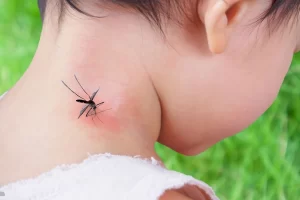
A mosquito is biting a kid
It is worth saying this plainly, because the statistics can feel abstract until you picture your own child.
Children are more vulnerable to mosquito-borne diseases for multiple reasons:
- Their immune systems are still developing. They mount weaker initial responses to novel infections, which means the disease has more time to establish itself before the body fights back.
- Their brains are still developing. Any virus that crosses the blood-brain barrier — West Nile, EEE, Zika — does disproportionate damage to a brain that is still building neural connections. The younger the child, the greater the potential for permanent developmental harm.
- They cannot protect themselves. A baby in a car seat cannot swat a mosquito. A toddler in the back seat does not understand why the window should stay closed. An infant does not cry differently when bitten versus when uncomfortable for any other reason. By the time a parent notices bites, the exposure has already happened.
- Their skin is thinner. Mosquitoes bite through children’s skin more easily and more quickly. The feeding time is shorter, which means even brief exposure — a two-minute stop with the window cracked — can result in bites.
- Allergic reactions are more common. Some children develop skeeter syndrome — an exaggerated allergic reaction to mosquito saliva that causes large, painful swelling, blistering, and sometimes fever. What looks like a normal bite on an adult can become a medical event on a young child.
A baby in a rear-facing car seat, in a car parked with the windows cracked at a soccer field in Florida, or a rest stop in Louisiana, or a campground in North Carolina — that baby is exposed to every mosquito in range. And the baby cannot do a single thing about it.
The parent can. The question is how.
The chemical trap: why insecticides and repellents are not the answer inside a car
The instinct is understandable. Mosquitoes are dangerous. Chemicals kill mosquitoes. Therefore: chemicals.
But a car is not a backyard. It is a small, enclosed, poorly ventilated space — often with a baby in it. The chemistry that works outdoors becomes a different equation inside a vehicle.
DEET
DEET is the most widely used mosquito repellent in the world, and it is effective. But the American Academy of Pediatrics recommends that DEET products should not be used on infants under 2 months old at all, and only at concentrations of 30% or less on older children. Inside a car — where the air volume is tiny and recirculation is limited — the effective concentration of DEET vapour in the cabin rises quickly. A child breathing DEET-saturated air in a sealed back seat is not getting the controlled, skin-surface application the product was designed for.
DEET can cause skin irritation, eye irritation, and in rare cases neurological effects in young children — including seizures. These cases are uncommon, but they are documented. And they are more likely in enclosed spaces with prolonged exposure, which is exactly what a car cabin creates.
Picaridin and other synthetic repellents
Picaridin is marketed as a gentler alternative. It is less irritating to skin and does not damage plastics. But it is still a synthetic chemical being aerosolised in a confined space with an infant. The long-term effects of repeated inhalation exposure in children are not well studied. “Less harsh than DEET” is not the same as “safe to breathe in a closed car with a newborn.”
Permethrin-treated surfaces
Permethrin is an insecticide used to treat clothing, gear, and fabrics. It kills mosquitoes on contact. It is highly effective outdoors. But permethrin is toxic to cats, can irritate skin on direct contact, and should never be applied to skin directly. Inside a car where a baby touches every reachable surface, permethrin-treated fabrics introduce a contact and inhalation risk that most parents would prefer to avoid if they knew about it.
Plug-in repellents and car-mounted insecticide devices
Some products release insecticidal vapour (often allethrin or metofluthrin) inside the vehicle. These are designed to kill or repel mosquitoes in the cabin. They work. But they work by filling the air inside a small enclosed space with a chemical that is toxic to insects — and insects are not the only living things breathing that air.
Allethrin is a pyrethroid — the same chemical class used in household bug bombs and flea sprays. It is a neurotoxin to insects, and at sufficient concentration, it can cause respiratory irritation, headaches, and nausea in humans. In a car with the windows up and a child in the back seat, “sufficient concentration” arrives faster than the product label suggests.
The bigger picture: chemicals and the environment
Beyond personal health, there is a broader concern. The widespread use of synthetic insecticides — DEET, pyrethroids, neonicotinoids — has documented consequences for ecosystems. Pyrethroids wash into waterways and are highly toxic to aquatic life, killing fish, amphibians, and beneficial insects including pollinators. DEET has been detected in municipal water supplies.
The global push toward chemical mosquito control has also accelerated resistance. Mosquito populations in many regions are developing resistance to pyrethroids and other insecticides, which means higher doses are needed for the same effect — which means more chemical exposure for humans and the environment, for diminishing returns.
Using chemicals to solve a mosquito problem inside a car — when a simple physical barrier would prevent the problem entirely — is reaching for the most complicated and potentially harmful tool when the simplest one works better.
The simplest solution is physical, not chemical
Your house does not use insecticide to keep mosquitoes out of the kitchen. It uses a window screen. The screen is simple, effective, non-toxic, and permanent. It does not wear off. It does not require reapplication. It does not make anyone sick. It does not pollute anything. It just works.
The question is: why does your car not have one?
Mosquitoes are spreading — and your state is probably on the list
If it feels like there are more mosquitoes than there used to be, it is because there are.
Warmer temperatures are extending mosquito season across the United States. Species that were once confined to the Gulf Coast are moving north. The Asian tiger mosquito (Aedes albopictus) — an aggressive daytime biter that carries dengue, Zika, and chikungunya — has now been documented in over 40 US states. The Aedes aegypti, the primary vector for Zika, has expanded its established range well beyond South Florida.
Wetter seasons mean more standing water, more breeding sites, and more mosquitoes. Warmer winters mean fewer die off between seasons. Each spring starts with a larger baseline population than the year before.
The worst states — the ones where driving with windows cracked is a genuine health decision, not just a comfort choice:
- Florida. The mosquito capital of the United States. Warm, wet, flat, and home to both Aedes aegypti and Aedes albopictus year-round. Locally transmitted dengue confirmed in Miami-Dade, Broward, Palm Beach, and other counties. If you park near the Everglades, near any canal, or near any puddle — your windows need screens.
- Louisiana. Bayou country. Standing water is not a defect of the landscape — it is the landscape. Mosquito season runs March through November. New Orleans and surrounding parishes are among the most mosquito-dense urban areas in the country.
- Mississippi. Humid, low-lying, and bisected by the most productive mosquito habitat in North America — the Mississippi River Delta.
- Texas. Houston, the Gulf Coast, and the Rio Grande Valley are hotspots. Locally transmitted Zika and dengue cases documented. West Nile virus every summer.
- Georgia, the Carolinas, Alabama. Warm summers, afternoon thunderstorms, suburban sprawl with poor drainage. Aggressive mosquito seasons and documented West Nile activity.
- Hawaii. Tropical climate, year-round mosquito activity, and past dengue outbreaks.
- The entire Northeast in summer. New Jersey, Connecticut, Massachusetts, New York — intense but shorter seasons, June through September. EEE is a particular concern in the Northeast’s swampy areas.
- The Midwest. Minnesota, Wisconsin, Michigan, and Iowa all deal with aggressive mosquito populations near lakes and wetlands. These states are often overlooked but produce some of the most intense seasonal mosquito activity in the country.
If you live in any of these states — or drive through them — a cracked car window without a screen is an open invitation.
When your car becomes a target
Mosquitoes do not wander into cars randomly. They follow CO2, body heat, and moisture — all of which every person in the car is producing. A parked car with cracked windows is broadcasting exactly the signals mosquitoes evolved to detect.
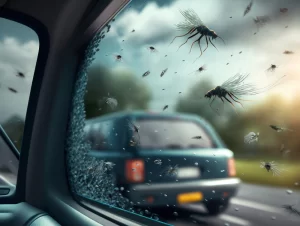
When bugs attack your car, Qualizzi are the best window screen barrier
- Parked with windows cracked. School pickup, sports practice, rest stops, trailheads, parking lots. The moment the windows go down for air, the car is open to anything that flies.
- Car camping or sleeping. If you are sleeping in your car with windows cracked, you are lying still, breathing steadily, and radiating heat. For a mosquito, this is the equivalent of a restaurant with an open door.
- Slow driving near water. Wetlands, rivers, lakes, marshes, irrigated suburbs. Driving slowly with windows open near any water source is peak exposure.
- Dawn and dusk. Most mosquito species are most active at first light and last light — the same times families are driving to and from outdoor activities.
- After rain. Standing water from recent rain means fresh breeding and a population surge. The 48–72 hours after a rainstorm are the worst.
Why other car sunshades don’t help with bugs
Most car sunshades require the window to stay closed. That solves the bug problem by eliminating ventilation entirely — which is not a solution. It is a different problem.
- Static cling shades stick to the glass. Window cannot open.
- Suction cup shades grip the glass. Window cannot open.
- Magnetic shades block or limit window travel. Minimal airflow.
- Roller shades leave gaps along the sides — exactly where mosquitoes enter.
- Loose DIY netting sags, gaps at the edges, no UV protection, looks temporary.
None of these act as a screen over an open window. They were designed for shade, not for insect protection. The two problems require fundamentally different designs.
How mesh shades turn car windows into bug screens
Sock-style mesh shades stretch over the entire door frame from the outside, covering both sides of the glass. When the window rolls down, the glass slides between the two mesh layers — and the mesh stays in place over the opening.
Window open. Air flowing. Mosquitoes blocked.
It is the same principle as a window screen in your house. Physical barrier. No chemicals. No expiry date. No reapplication. No side effects. Just mesh between your family and the insects outside.
Qualizzi is the best car window bug screen
Qualizzi sunshades were not designed as a mosquito product. They were designed as a sun shade that happens to do something no other car shade does: cover the full window opening with a tensioned mesh screen while the window is down. The bug protection is a natural consequence of the design — and for many families, it is the feature that matters most.
Double-layer mesh weave. Qualizzi uses 40D spandex yarn in a double-layer construction. The weave is tight enough to block mosquitoes, flies, wasps, gnats, and other biting insects while allowing air to pass through freely. This is not loose netting draped over a frame. It is an elastic, tensioned mesh that conforms to the window shape and stays taut. No sagging. No gaps. No openings for insects to exploit.
Full window coverage. The mesh wraps around the entire door frame. Top, bottom, left, right — fully sealed. Unlike loose netting, partial shades, or roller shades with side gaps, there is no edge where a mosquito can slip through. Every centimetre of the window opening is screened.
Works with the window fully open. This is the critical feature. You can roll the window all the way down while the Qualizzi shade stays in place. Air flows through the mesh. Insects do not. Ventilation and protection at the same time — which is the one combination that chemicals, closed windows, and every other shade type cannot deliver.
No chemicals. No toxins. No health risks. The mesh is spandex fabric. It does not release vapour. It does not irritate skin. It does not off-gas in a hot car. It does not require ventilation warnings on the label. It is safe for newborns, pregnant women, dogs, and anyone with chemical sensitivities. It is the only mosquito solution for a car that introduces zero health risk to the people inside it.
97% UV protection. While screening bugs, the same mesh also blocks 97% of solar radiation — measured with a solar meter and published with full methodology on the Qualizzi UV test page. One product. Bug screen, sun shade, UV blocker, privacy screen, and airflow — all at once.
9 sizes for a sealed fit. A screen with gaps is not a screen. It is a suggestion. Qualizzi offers 9 sizes from XS to XXXXL — one of the widest ranges in the sunshade market. The right size means the mesh sits taut against the frame with no slack, no bunching, and no loose edges. For bug protection, this is critical. One gap is one mosquito. One mosquito carrying dengue or West Nile is one too many.
10-second install. No tools. Open the door. Stretch the shade over the frame. Close the door. Faster than applying bug spray to one arm — and unlike spray, it protects everyone in the car, does not wear off, and does not need reapplication after sweating, swimming, or time.
Comparison: bug protection by sunshade type
| Type | Blocks Bugs? | Can window open? | Airflow? | Full Coverage? | UV Protection? | Chemical-Free? |
|---|---|---|---|---|---|---|
| Qualizzi (Sock Mesh) | Yes | Yes — fully | Yes | Yes | 97% (tested) | Yes |
| Static Cling | No | No | None | Partial | Low–Medium | Yes |
| Suction Cup | No | No | None | Partial | Low–Medium | Yes |
| Magnetic | No | Rarely | Low | Full/near | Varies | Yes |
| Roller | No — gaps | No | None | Partial | Low | Yes |
| DIY Loose Netting | Partially | Yes | Yes | Poor fit | None | Yes |
| Bug Spray (DEET) | Repels, doesn’t block | N/A | N/A | N/A | None | No |
| Plug-In Repellent | Repels/kills in cabin | N/A | N/A | N/A | None | No |
Frequently Asked Questions
Do Qualizzi car shades actually keep mosquitoes out?
Yes. The double-layer spandex mesh covers the full window opening when the window is rolled down. The weave is tight enough to block mosquitoes, flies, gnats, and wasps while still allowing air to pass through. It works on the same principle as a window screen in a house — physical barrier, not chemical.
Can I use Qualizzi shades as a mosquito net while sleeping in the car?
Yes. This is one of the most practical uses. When you are sleeping in your car with windows cracked for ventilation, Qualizzi shades keep insects out while letting fresh air circulate. Unlike loose netting that sags or gaps, the mesh stays taut and sealed around the frame — no openings for mosquitoes to exploit while you sleep.
Are Qualizzi shades safer than bug spray for babies?
Qualizzi shades are spandex mesh. They release no chemicals, no vapour, and no residue. The American Academy of Pediatrics advises against using DEET on infants under 2 months and recommends limited use on older children. Inside a car — a small, enclosed space — chemical repellent vapour concentrations rise quickly. A physical mesh barrier avoids the question entirely. No chemicals touch the baby. No chemicals enter the air the baby breathes.
Do mesh shades block all types of bugs?
The mesh blocks any insect too large to pass through the weave — which includes mosquitoes, flies, wasps, hornets, beetles, moths, and most gnats. Extremely small insects like no-see-ums (biting midges) may be small enough to pass through some mesh weaves. For the vast majority of biting and nuisance insects encountered in the US, Qualizzi’s double-layer mesh is an effective barrier.
I live in Florida. Are these worth it?
Florida has year-round mosquito activity, both Aedes vector species, and documented local transmission of dengue. If you park with windows cracked, wait at school pickup, rest at a trailhead, or spend any time stopped near water or vegetation, Qualizzi mesh shades are one of the most practical investments you can make. They turn every window into a screened opening — which is what every Florida driver needs most of the year.
Can mosquitoes get through the mesh if they land on it?
Landing on the mesh is not the same as getting through it. The weave is tight enough that a mosquito sitting on the outside surface cannot push through to the inside. This is different from loose netting where insects can push fabric aside or find slack points. Qualizzi’s elastic tension keeps the mesh taut — there are no loose spots to exploit.
Will the mesh keep wasps and bees out too?
Yes. Wasps, bees, hornets, and yellow jackets are all too large to pass through the mesh. If you park near flowering areas, outdoor dining, or bins where wasps gather, the mesh blocks them from entering the car while still allowing ventilation.
What size Qualizzi shade do I need for bug protection?
The same sizing applies as for sun protection — measure your window and match to Qualizzi’s 9-size range (XS to XXXXL). For bug protection, correct sizing is especially important: an oversized shade creates slack where insects can find gaps, and an undersized shade may not cover the full opening. One gap is all a mosquito needs. Use the Qualizzi sizing guide for the right fit.
Do I need shades on all windows for bug protection?
Any open window without a mesh screen is an entry point. If you only crack two windows, you need shades on those two. For full ventilation — especially when parked or camping — most families benefit from covering all side windows. Qualizzi shades install on any door with a standard frame.
Final thought
Your house has screens on the windows. Your tent has screens on the doors. Your car — the place where your baby rides, your dog travels, your family spends hours every week — has nothing.
That made sense when mosquitoes were just annoying. It does not make sense anymore. Not when the mosquitoes in your state carry diseases that cause brain damage in children, birth defects in pregnancies, and organ failure in adults. Not when the alternative to a screen is spraying neurotoxic chemicals in an enclosed space with an infant breathing the air.
The solution is not complicated. It is not expensive. It is not chemical. It is a screen.
Qualizzi sunshades turn your car windows into screened openings. Double-layer 40D spandex mesh. Full window coverage. 97% UV blocking. 9 sizes. 10-second install. No tools. No chemicals. No health risks. The window stays open. The air flows in. The mosquitoes — and everything they carry — stay out.
Find the best car window bug screen for your vehicle on the Qualizzi website or the Qualizzi Amazon store.
bugs protectioncar bug net for windowscar camping mosquito netcar sunshades that let you roll down windowscar window bug screencar window mesh for bugscar window netcar window sun shadescar window sunshadesfull coverage car shademosquito net for car side windowsqualizziQualizzi mosquito car shadequalizzi sun shades