No products in the cart.
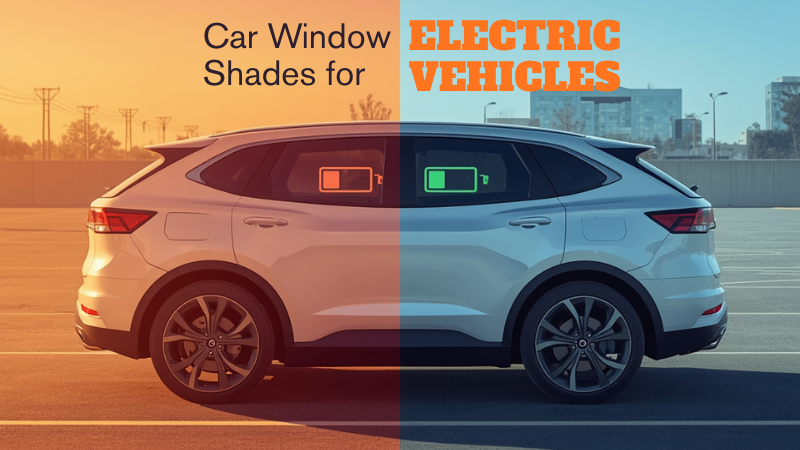
Car Window Shades for Electric and Hybrid Vehicles: How Blocking Sun Through Your Windows Can Help Preserve EV Battery Range
Summary: Electric vehicle owners lose up to 40% of their battery range to climate control on hot days, according to AAA testing. The primary drain is not the motor, the terrain, or battery degradation — it is the air conditioning system, which draws 3,000 to 5,000 watts from the same battery pack that propels the vehicle, according to fleet data from Geotab’s analysis of 5.2 million EV trips. Every degree the cabin temperature rises while the vehicle is parked in direct sunlight is a degree the A/C must work to remove when driving begins, drawing energy away from range. This guide examines the published data on heat, air conditioning load, and EV range loss; explains the mechanism by which car window shades reduce cabin temperature before driving begins; and provides the most comprehensive vehicle compatibility table currently available for Qualizzi pull-over mesh shades — covering 44 electric vehicle models and 40 hybrid and plug-in hybrid models across every segment of the U.S. market. Qualizzi has been producing fitment data for electrified vehicles since 2016, and this guide represents the most complete and verified compatibility reference we have published to date.
Table of Contents
- Introduction: The EV Range Problem That Starts in Your Parking Lot
- The Science: How Heat Drains Your EV Battery
- What Car Window Shades Do to Cabin Temperature
- The Range Equation: Connecting Shades to Battery Preservation
- Why Mesh Sleeve Shades Are the Best Fit for Electric Vehicles
- Framed vs. Frameless Doors: Why It Matters for Compatibility
- EV Compatibility Table: Size by Size
- Hybrid & PHEV Compatibility Table: Size by Size
- Beyond Range: Additional EV and Hybrid Benefits
- How to Install Qualizzi Shades on Your EV or Hybrid
- How to Choose the Right Size
- Frequently Asked Questions
- Sources
1. Introduction: The EV Range Problem That Starts in Your Parking Lot
If you own an electric vehicle, you have thought about range. You have compared rated miles, planned charging stops, and monitored your state of charge on long trips. But there is one significant factor draining your battery that most EV owners never consider: the sun heating your car while it sits in a parking lot.
When an electric vehicle is parked in direct sunlight for one to two hours, cabin temperatures routinely climb to between 130 and 170 degrees Fahrenheit. When you return to the vehicle and engage the air conditioning, the battery must cool that superheated interior down to a comfortable temperature. That process draws 3,000 to 5,000 watts from the same battery pack that drives the motor — energy that is no longer available for range.
In a gasoline vehicle, the A/C compressor runs off the engine via a belt. The fuel penalty exists but is marginal. In an electric vehicle, every watt spent cooling the cabin is a watt not spent driving. The relationship is direct, measurable, and well-documented in fleet research.
This guide connects two independently established facts: car window shades significantly reduce cabin heat buildup while parked, and lower cabin temperatures measurably reduce the A/C load that drains EV batteries. The logical chain is not speculative — it follows directly from thermal physics and published energy consumption data. If you drive an electric or hybrid vehicle and park outdoors regularly, window shades are not a comfort accessory. They are a range-preservation tool.
Qualizzi has been manufacturing pull-over mesh window shades and compiling vehicle fitment data since 2016. With over 6,400 verified customer reviews and compatibility data now covering 162 vehicle models across gas, electric, and hybrid powertrains, we are, to our knowledge, the only window shade manufacturer to have published a verified, size-specific compatibility guide for electrified vehicles in the U.S. market. This guide is the result of that research.
2. The Science: How Heat Drains Your EV Battery
2.1 The A/C Power Draw
In an electric vehicle, the air conditioning compressor is driven directly by the high-voltage battery pack. There is no engine to absorb the mechanical load. Every watt the compressor uses reduces the energy available for propulsion.
According to Geotab’s analysis of 5.2 million EV trips across 4,200 vehicles representing 102 different models, cabin heating and cooling systems draw between 3,000 and 5,000 watts from the battery pack. For reference, heated seat elements draw approximately 75 watts. Running the A/C draws 40 to 67 times more energy than a heated seat. This is not a design flaw specific to any manufacturer — it is a thermodynamic requirement. Moving heat energy requires substantial power, and the greater the temperature differential between the cabin and the target comfort level, the more energy is required to close that gap.
2.2 Measured Range Loss from Heat and Climate Control
Geotab’s fleet research identified 70 degrees Fahrenheit (21.5°C) as the optimal ambient temperature for electric vehicle efficiency. At this temperature, the average EV in their dataset achieved 115% of its EPA-rated range. Most EVs maintain 100% or more of rated range between 50 and 88 degrees Fahrenheit.
Once ambient temperatures rise above that window and climate control is engaged, range declines. AAA conducted controlled testing of several popular EV models and found that temperature alone reduced range by 10 to 12%. When active climate control was included in the measurement, total range loss reached up to 40%, as documented by Recurrent Auto’s analysis of real-world EV range data.
Practical illustration: For an EV with a rated range of 300 miles, a 40% reduction from climate control leaves 180 miles of usable range. That is 120 miles lost — not to speed, terrain, or battery age, but to cooling a cabin that heated up in a parking lot.
The same principle applies to plug-in hybrids (PHEVs) operating in electric mode. When the electric range is partially consumed by A/C load before the combustion engine takes over, the overall fuel efficiency advantage of the PHEV is diminished. Standard hybrids (HEVs) are less affected because the combustion engine assists with A/C load, but any reduction in thermal stress on the system contributes to overall efficiency.
2.3 What Happens Inside a Parked Car in the Sun
The greenhouse effect inside a parked vehicle is well-documented in automotive and occupational safety research. Solar energy passes through window glass, is absorbed by interior surfaces — the dashboard, seats, headliner, and trim — and is re-radiated as infrared energy that cannot escape back through the glass. The cumulative result is rapid and extreme temperature buildup:
- On an 80°F (27°C) day, a vehicle interior reaches approximately 130°F (54°C) within 30 minutes
- On a 95°F (35°C) day, interior temperatures regularly exceed 170°F (77°C)
- Dashboard surfaces in direct sunlight can reach 195°F (91°C) or higher
- Seat surfaces exposed to direct sunlight can reach 150 to 160°F (65–71°C)
When you return to your EV after it has been parked for one hour, the air conditioning is not cooling from 95°F to 72°F — it is cooling from 140°F or 150°F to 72°F. That is nearly twice the thermal load, and it draws continuously from the battery for the entire cool-down period, which can extend well into the first several miles of driving.
3. What Car Window Shades Do to Cabin Temperature
Car window shades intercept solar radiation before it enters the cabin and heats interior surfaces. The effectiveness of any shade depends on three variables: the proportion of the window it covers, the percentage of solar energy the material blocks, and whether the shade is positioned on the glass itself (reflecting heat inward from a surface already inside the cabin) or on the door frame (intercepting solar energy before it reaches the glass entirely).
Qualizzi shades are designed to cover the entire window opening from frame edge to frame edge, with no gaps through which direct sunlight can pass. Independent in-car testing using both a UVA meter and a solar irradiance meter confirmed that Qualizzi mesh blocks 97% of solar energy across the covered window area. The full test methodology and results are published on our website.
The result is a measurable reduction in the rate of cabin heat buildup through treated windows. Seats, belts, and trim behind shaded glass accumulate significantly less thermal energy during a parking period. The cabin temperature at the time of re-entry is materially lower than it would be with bare glass, and the A/C system faces a proportionally smaller thermal load when driving begins.
A note on transparency: No published peer-reviewed study has measured, in a single controlled experiment, the installation of Qualizzi shades on an EV followed by a direct measurement of resulting range improvement. What exists in the literature are two independently proven facts — shades reduce cabin heat buildup, and lower cabin temperatures reduce A/C energy consumption — connected by straightforward thermodynamic logic. We present this as a well-supported inference grounded in published data, not as a directly measured claim.
4. The Range Equation: Connecting Shades to Battery Preservation
The mechanism operates in five sequential steps:
Step 1 — Solar heat enters the unprotected cabin. Without window shades, interior surfaces absorb direct solar radiation and re-radiate it as heat. Cabin temperatures reach 130–170°F during a typical summer parking period of one to two hours.
Step 2 — The driver returns and engages the A/C. The air conditioning compressor activates and begins drawing 3,000–5,000 watts from the battery to reduce cabin temperature from 140°F or higher to the driver’s comfort target, typically 70–72°F.
Step 3 — A/C load reduces range. AAA and Geotab data confirm that climate control under hot conditions reduces EV range by 10 to 40%, depending on ambient temperature, vehicle efficiency, and how long the vehicle was parked.
Step 4 — Window shades reduce the starting temperature. With Qualizzi shades blocking 97% of solar energy through the rear windows during the parking period, the cabin begins at a lower temperature. Instead of cooling from 150°F, the A/C may only need to cool from 110–120°F — a reduction of 25–30% in the required thermal work.
Step 5 — Less cooling required means less battery drain. The A/C system operates at lower intensity and for a shorter duration. The energy saved remains in the battery and is available for driving range.
The precise number of miles preserved depends on the specific vehicle, ambient temperature, parking duration, A/C settings, and how many windows are shaded. The direction, however, is unambiguous and consistent with established thermodynamic principles: anything that reduces the initial cabin temperature reduces the energy the battery must expend on cooling, which extends available range.
For EV owners who regularly park outdoors — at workplaces, shopping centers, airports, or during extended road trip stops — the cumulative effect over days, weeks, and years is substantial. Window shades function as passive pre-conditioning: they reduce cabin heat without drawing any energy from the battery, operating continuously at zero ongoing cost.
5. Why Mesh Sleeve Shades Are the Best Fit for Electric Vehicles
EV owners have specific requirements that make certain shade designs more effective than others. Pull-over mesh sleeve shades — the design Qualizzi has manufactured since 2016 — offer several properties that align particularly well with electric vehicle use cases.
Zero battery draw
Unlike built-in electrochromic glass or powered shading systems offered on some premium EVs, Qualizzi shades are entirely passive. They block 97% of solar energy without drawing a single watt from the battery pack. Protection is continuous whether the vehicle is parked, charging, in sleep mode, or driven with the windows down.
Ventilation without compromise
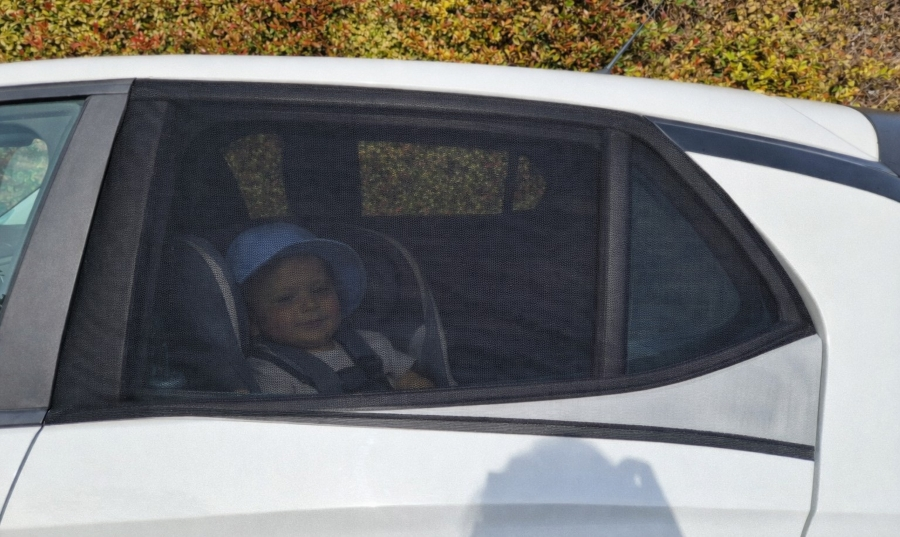
Because Qualizzi shades grip the door frame — not the glass itself — the window can be rolled down fully with the shade in place. On mild days, natural ventilation through the mesh eliminates the need for A/C entirely, preserving battery range with no thermal penalty and no insect intrusion.
Passive protection that works without Cabin Overheat Protection
Systems such as Tesla’s Cabin Overheat Protection, Ford’s similar feature on the F-150 Lightning, and equivalent functions on other EVs maintain interior temperature while parked by running the A/C from the battery. They are effective but consume stored energy. Qualizzi shades reduce the rate of heat buildup passively, meaning Cabin Overheat Protection activates less frequently, consumes less energy when it does activate, and the battery retains more charge for driving.
Negligible weight penalty
Vehicle mass directly affects EV range. A pair of Qualizzi shades weighs a few ounces. There is no mounting hardware, no rigid frames, no adhesive components. The mass added to the vehicle is effectively zero relative to any measurable range impact.
UV protection for EV-specific interior materials
Electric vehicle interiors frequently use synthetic vegan leather, recycled textiles, and bio-based plastics that can be more susceptible to UV degradation than traditional automotive leather. Sustained UV exposure accelerates fading, cracking, and material breakdown. Blocking 97% of UV radiation through the rear windows preserves these materials over the vehicle’s lifespan. For a more detailed comparison, see our analysis of window tinting versus mesh shades for UV protection.
6. Framed vs. Frameless Doors: Why It Matters for Compatibility
Qualizzi shades use a pull-over sleeve design that stretches around the door frame — the metal arch that surrounds the window glass when the door is open. This design is what enables tool-free installation in under two minutes, a secure fit at highway speeds, and the ability to operate the window while the shade remains in place.
The design requires a framed door: one with a visible metal arch running along the top and sides of the window opening. On frameless doors — where the glass rises directly above the door panel with no surrounding metal frame — there is nothing for the elastic edge to grip securely.
How to check your door type: Open a rear door and examine the top edge of the window opening. If a metal frame runs along the top and sides of the glass, your door is framed and compatible. If the glass simply rises above the door panel without a surrounding frame, your door is frameless and Qualizzi shades are not recommended for that door position.
The critical practical point for EV owners is this: most electric SUVs, crossovers, trucks, and vans have framed rear doors, even when the front doors are frameless. Since Qualizzi shades are primarily used on rear windows — where passengers, children, pets, and cargo are most exposed to direct sun — the majority of popular EVs in the U.S. market are compatible.
The following popular EVs have frameless doors on all four positions and are therefore not compatible with Qualizzi pull-over sleeve shades: Tesla Model 3, Tesla Model S, BMW i4, Polestar 2, Hyundai Ioniq 6 (front doors only — rear doors are framed and compatible), Mercedes-Benz EQS sedan, and Lucid Air. For these vehicles, our guide to window shade types covers alternatives that work with frameless glass.
Note on the Hyundai Ioniq 6 specifically: despite its highly aerodynamic, sloping roofline, the Ioniq 6 does not have frameless rear doors. The rear side windows are surrounded by a standard metal door frame, and the vehicle is fully compatible with Qualizzi shades in the L to XL size range.
7. Electric Vehicle Compatibility: Recommended Qualizzi Size by Window Dimension
The following table organizes compatible electric vehicles by Qualizzi size, based on typical rear side window dimensions for each vehicle category in the U.S. market. This is the most comprehensive EV fitment reference of its kind currently published by any window shade manufacturer. Always measure your specific windows and verify against the full interactive EV compatibility guide before purchasing.
Tip: If you are between two sizes, select the larger size. The elastic mesh can compress slightly for a tighter fit, but a shade that is too small will not achieve full window coverage.
| Qualizzi Size | Approx. H × W | Shape | Compatible EV models (rear door) |
|---|---|---|---|
| XXXXL | 30″ × 50″–52″ | RECT | Ford E-Transit High Roof, Mercedes eSprinter, Ram ProMaster EV |
| XXXL | 24″–27″ × 46″–50″ | RECT | Ford F-150 Lightning, Chevy Silverado EV, GMC Sierra EV, GMC Hummer EV, Kia EV9, Rivian R1S, Volvo EX90 |
| XXXL | 24″–27″ × 46″–50″ | TAPER | Front door: F-150 Lightning, Silverado EV, Sierra EV, Hummer EV, EV9, R1S |
| XXL | 22″–23″ × 42″–48″ | RECT | Rivian R1T, Rivian R1S (2nd row), Volkswagen ID.Buzz, Kia EV9 (2nd row) |
| XL | 19″–21″ × 42″–46″ | RECT | Tesla Model Y, Ford Mustang Mach-E, Hyundai Ioniq 5, Hyundai Ioniq 6, Kia EV6, Chevy Equinox EV, Chevy Blazer EV, VW ID.4, Honda Prologue, Toyota bZ4X / bZ, Nissan Ariya, Cadillac Lyriq, Subaru Solterra, Volvo EX40, Rivian R2 |
| L | 17″–18″ × 38″–42″ | RECT | Chevy Bolt EV / EUV, Nissan Leaf, Hyundai Kona Electric, Kia Niro EV, Mazda MX-30 |
| M to ML | 16.5″–19.5″ × 35″–42″ | RECT | Chevy Bolt EV (original gen), Mini Cooper SE, Nissan Leaf (older generations) |
| ML | 17″–19.5″ × 37″–42″ | TAPER | Front door: Model Y, Ioniq 5, Ioniq 6, EV6, Equinox EV, Mach-E, VW ID.4, Prologue, bZ4X, Ariya, Solterra, Niro EV, Kona EV, Bolt EUV |
For the full searchable compatibility guide including front door sizes, frameless status, and notes for every model: qualizzi.com/car-window-sunshades-ev-compatibility-guide/
8. Hybrid & Plug-In Hybrid Compatibility: Recommended Qualizzi Size by Window Dimension
Hybrid and plug-in hybrid vehicles share their door frames, window dimensions, and body panels with the equivalent gasoline versions of each model. The hybrid powertrain does not alter the window geometry. The fitment data below applies equally to HEV and PHEV variants of each listed model unless otherwise noted.
The range preservation logic from Sections 3 and 4 applies most directly to PHEVs operating in electric mode, where A/C load draws from the battery pack rather than the combustion engine. For standard HEVs, the benefit is indirect — reduced thermal stress on the system and lower ambient temperatures around the battery management electronics — but the UV protection, interior preservation, and passenger comfort benefits apply regardless of powertrain.
| Qualizzi Size | Approx. H × W | Shape | Compatible hybrid models (rear door) |
|---|---|---|---|
| XXXL | 24″–27″ × 46″–50″ | RECT | Ford F-150 Hybrid HEV, Toyota Sequoia Hybrid HEV, Hyundai Palisade Hybrid HEV, Kia Telluride Hybrid HEV, Mazda CX-90 PHEV PHEV, VW Atlas PHEV PHEV |
| XXL | 22″–23″ × 42″–48″ | RECT | Toyota Tacoma Hybrid HEV, Ram 1500 Hybrid HEV, Ford Explorer Hybrid HEV, Toyota Highlander Hybrid HEV, Kia Sorento Hybrid/PHEV HEV+PHEV, Hyundai Santa Fe Hybrid/PHEV HEV+PHEV, Jeep Grand Cherokee 4xe PHEV, Jeep Gladiator 4xe PHEV |
| XL | 19″–21″ × 42″–46″ | RECT | Toyota RAV4 Hybrid HEV, Toyota RAV4 Prime PHEV, Honda CR-V Hybrid HEV, Hyundai Tucson Hybrid/PHEV HEV+PHEV, Kia Sportage Hybrid/PHEV HEV+PHEV, Ford Escape Hybrid/PHEV HEV+PHEV, Nissan Rogue Hybrid/PHEV HEV+PHEV, Mazda CX-50 Hybrid HEV, Toyota Camry Hybrid HEV, Honda Accord Hybrid HEV, Hyundai Sonata Hybrid HEV, Kia K5 Hybrid HEV, Subaru Outback Hybrid HEV, Subaru Forester Hybrid HEV, Volvo XC40 PHEV PHEV |
| L | 17″–18″ × 38″–42″ | RECT | Toyota Corolla Hybrid HEV, Honda Civic Hybrid HEV, Hyundai Elantra Hybrid HEV, Kia Niro Hybrid/PHEV HEV+PHEV, Hyundai Kona Hybrid HEV, Toyota Corolla Cross Hybrid HEV, Subaru Crosstrek Hybrid PHEV |
| M Curved | 16.5″–17.5″ × 35″–42″ | CURVED | Toyota Prius / Prius Prime HEV+PHEV — aerodynamic sloping rear hatch requires Curved shape |
For the full searchable hybrid compatibility guide including front door sizes, PHEV electric range data, and notes for every model: qualizzi.com/car-window-sunshades-hev-compatibility-guide/
9. Beyond Range: Additional Benefits for EV and Hybrid Owners
Reduced pre-conditioning time and energy
Pre-conditioning — running the A/C while the vehicle is still connected to a charging source — is universally recommended by EV manufacturers as the most energy-efficient way to achieve cabin comfort before driving. Geotab, Recurrent, and all major OEM guidance endorse this practice. A shaded cabin, however, starts at a lower temperature, which means pre-conditioning completes faster and draws less grid energy. Over hundreds of pre-conditioning cycles per year, the cumulative grid electricity savings are meaningful.
Battery longevity
Research from Recurrent Auto indicates that sustained exposure to high temperatures accelerates electrochemical degradation in lithium-ion battery cells, specifically through side reactions in the cell’s protective electrolyte layer. While the vehicle’s battery management system regulates pack temperature actively, maintaining a cooler overall cabin environment — particularly during prolonged outdoor parking — reduces the thermal load on the battery management system and the ambient temperature surrounding the pack. Lower operating temperatures are consistently associated with longer battery service life across lithium chemistry types.
Dog Mode and Camp Mode efficiency
EV owners who use Tesla’s Dog Mode, Ford’s similar feature, or equivalent functions on other platforms to protect pets during brief stops are drawing from the battery continuously to maintain cabin temperature. Window shades reduce the rate of heat buildup, which means the A/C cycles less frequently and the battery lasts proportionally longer before the mode terminates or reaches a low-charge warning. For a detailed treatment of this use case, see our guide to car sunshades for dogs and pets.
EV camping and overnight stays
Car camping in electric vehicles is a rapidly growing segment, driven by the availability of Camp Mode, large battery reserves, and built-in climate control. Qualizzi mesh shades allow windows to remain open for ventilation throughout the night while blocking insects, UV radiation, and external visibility — all without engaging climate control. This preserves battery charge for morning driving rather than overnight comfort management. For extended treatment of this use case, see our car camping window shade guide.
Touchscreen glare reduction
Center-mounted infotainment screens are standard on virtually every electric and hybrid vehicle currently on sale. Direct sunlight through rear side windows creates cabin glare that degrades screen readability, affecting navigation accuracy, energy monitoring, and ADAS interface legibility. Qualizzi mesh filters intense lateral light without darkening the cabin to an uncomfortable degree, maintaining screen readability without requiring brightness adjustments that themselves consume additional power.
10. How to Install Qualizzi Shades on Your EV or Hybrid
Installation is identical across all compatible vehicle types — gasoline, electric, or hybrid. The process requires no tools, adhesives, or vehicle modifications and takes under two minutes for both rear windows.
- Open the rear door fully. Work from outside the vehicle for the easiest access.
- Position the top edge of the shade over the top of the door frame. The reinforced elastic edge grips the frame immediately on contact.
- Pull the shade downward and around the door frame, stretching it over the bottom of the window opening. The double-layer 40D spandex mesh conforms to the window shape under tension.
- Close the door. The shade is secured in place by the door frame and the closing pressure.
- Repeat on the other rear door.
- Test window operation. Roll the window up and down fully. The shade remains in place throughout the range of motion.
Sensor compatibility: Qualizzi shades cover the window glass area of the side doors only. They do not cover B-pillar cameras, side-mirror cameras, ultrasonic sensors, LiDAR units, or any ADAS components. Side-window cameras used by Tesla and other manufacturers for driver-assist systems are mounted in the B-pillar or adjacent to the mirrors, outside the window area covered by the shade.
11. How to Choose the Right Size for Your Electric or Hybrid Vehicle
- Confirm door frame compatibility. Open a rear door and verify there is a metal frame surrounding the window opening. See Section 6 for the full explanation of framed versus frameless doors.
- Consult the compatibility tables above or the full interactive guides linked below to find the recommended starting size for your specific model.
- Measure your rear side windows if your model is not listed. Measure the height from the top of the metal frame to the base of the window seal, and the width from the front edge to the rear edge of the frame. Match these measurements to the size ranges in the tables above.
- When between sizes, select the larger size. The elastic mesh accommodates a range of dimensions — a shade that is slightly large can be stretched slightly tighter, but a shade that is too small will not achieve full frame-to-frame coverage.
- Wrong size? Free replacement. If the size you order does not fit correctly, Qualizzi replaces it at no charge.
Preserve your EV’s range with the only window shade engineered for frame-to-frame coverage.
97% solar block · 9 sizes · Zero battery draw · Over 6,400 verified reviews · Winner of the Mom’s Choice Award and National Parenting Approval Seal.
12. Frequently Asked Questions
Do car window shades help preserve EV battery range?
Yes, through a well-documented indirect mechanism. Window shades reduce cabin heat buildup while the vehicle is parked. A cooler cabin requires less air conditioning energy when driving begins. Since A/C systems draw 3,000 to 5,000 watts from the EV battery — equivalent to 40 to 67 times the draw of a heated seat — any reduction in cooling demand directly preserves range. The precise miles saved depend on ambient temperature, parking duration, and vehicle efficiency, but the thermodynamic relationship between lower cabin temperature and reduced A/C energy consumption is established in Geotab’s fleet analysis of 5.2 million trips.
How much range does air conditioning cost on an electric car?
AAA testing found that climate control can reduce EV range by up to 40% under extreme temperature conditions. Under more typical summer driving, the range penalty from active A/C use is approximately 10 to 20%. For an EV rated at 300 miles of range, that represents 30 to 90 miles consumed by cabin cooling rather than propulsion.
Will Qualizzi shades fit a Tesla Model Y?
Yes. The Tesla Model Y has framed rear doors and is fully compatible with Qualizzi pull-over sleeve shades. The recommended starting size is L to XL for the rear doors. Measure your specific rear side windows to confirm the exact size. The front doors on the Model Y are frameless; shades are recommended for rear use on this vehicle.
Will Qualizzi shades fit a Tesla Model 3?
No. The Tesla Model 3 has frameless doors on all four positions. Qualizzi pull-over sleeve shades require a metal door frame to grip and are not compatible with the Model 3. Alternative shade types for frameless doors are discussed in our guide to window shade types.
Does the Hyundai Ioniq 6 have frameless doors?
The Ioniq 6 has frameless front doors but framed rear doors. Despite its highly aerodynamic, sloping roofline — which gives the appearance of a frameless design — the rear side windows are surrounded by a standard metal door frame. The Ioniq 6 is compatible with Qualizzi shades in the L to XL size range for the rear doors.
Do Qualizzi shades work on plug-in hybrid vehicles?
Yes. Plug-in hybrid vehicles share their door frames, window dimensions, and body panels with the gasoline or standard hybrid versions of the same model. The PHEV powertrain does not alter window geometry. All hybrid and PHEV models listed in Section 8 are fully compatible. For PHEVs operating in electric mode, the range preservation benefits described in this guide apply directly, since the A/C draws from the battery pack rather than the combustion engine.
Do the shades interfere with EV sensors or cameras?
No. Qualizzi shades cover only the window glass area of the side doors. They do not cover B-pillar cameras, side-mirror cameras, ultrasonic proximity sensors, LiDAR units, or any other ADAS components. Side-window cameras used by Tesla and other manufacturers for driver-assist and Sentry Mode functions are mounted outside the window area that the shade covers.
Are Qualizzi shades better than Tesla Cabin Overheat Protection?
They serve complementary rather than competing functions. Cabin Overheat Protection actively runs the A/C while parked to maintain interior temperature below a set threshold, which draws from the battery. Qualizzi shades passively reduce the rate of heat buildup, meaning Cabin Overheat Protection activates less frequently and consumes less energy when it does activate. Using both together is the most effective approach: the shades reduce the thermal load, and Cabin Overheat Protection manages any residual heat that does accumulate.
Can I use the shades while the vehicle is charging?
Yes. Qualizzi shades remain on the vehicle at all times and function continuously regardless of whether the vehicle is parked, charging, in sleep mode, or being driven. There is no interaction between the shade and the charging system or port.
What size do I need for a Ford F-150 Lightning?
The F-150 Lightning shares the body and door dimensions of the F-150 gasoline Crew Cab. The recommended starting point is XXXL for the rear doors and XXXL Tapered for the front doors. Verify against your specific window measurements, as trim-level variations can affect window dimensions slightly. If you order the wrong size, Qualizzi replaces it at no charge.
Do window shades protect EV battery health over time?
Indirectly, yes. Research from Recurrent Auto documents that sustained high-temperature exposure accelerates electrochemical degradation in lithium-ion battery cells. While the vehicle’s battery management system regulates pack temperature, maintaining a cooler cabin environment — particularly during extended outdoor parking — reduces the ambient thermal load surrounding the battery. Lower operating temperatures are consistently correlated with longer service life across lithium battery chemistries. The benefit is incremental rather than dramatic, but it compounds over years of regular use.
Sources
- Geotab. Top EV Range Factors to Extend Fleet Efficiency. Analysis of 5.2 million trips across 4,200 vehicles and 102 EV models. geotab.com/blog/ev-range
- Recurrent Auto. Real Range for Electric Cars by Temperature and Weather. Includes AAA EV climate control range testing data. recurrentauto.com/research/how-temperature-affects-ev-range
- Qualizzi. UV Test: Full Coverage vs. Partial Coverage. In-car solar irradiance and UVA meter testing. qualizzi.com — UV Test Results
- Qualizzi. Electric Vehicle Compatibility Guide. Verified fitment data for 44 EV models in the U.S. market. qualizzi.com/car-window-sunshades-ev-compatibility-guide/
- Qualizzi. Hybrid & PHEV Compatibility Guide. Verified fitment data for 40 hybrid models in the U.S. market. qualizzi.com/car-window-sunshades-hev-compatibility-guide/
Related Guides on Qualizzi.com
- Gas & Diesel Vehicle Compatibility Guide — 78 models covered
- Hybrid & PHEV Compatibility Guide — 40 models covered
- Car Sunshades That Let You Roll Down Windows
- Types of Car Side Window Sun Shades Compared
- Glass Tinting vs. Car Window Mesh Shades
- Best Car Sunshades for Dogs and Pets
- Car Camping Window Shades: Stay Cool, Private, and Bug-Free
- Car Window Shade Cost in 2026: A Value Comparison